Tag: Beef

A collection of posts featuring Beef dishes.

  • Late Night Wonders: Immerse yourself in Frankfurt’s authentic Chinese snack culture

    Late Night Wonders: Immerse yourself in Frankfurt’s authentic Chinese snack culture

    In China, the concept of “late night snack” or “midnight snack” – known as 夜宵 (Yèxiāo) in Chinese – has a centuries-old tradition and is deeply rooted in Chinese culture. The concept encompasses a diverse range of dishes and snacks celebrated for their rich flavors, typically enjoyed at street stalls, night markets, and specialized late-night eateries. Língdiǎn Chuàn Ba (“零点串吧”, meaning “Midnight Skewer Bar” or “Midnight Skewer Grill”), located just five minutes from Frankfurt’s main train station, carries on this tradition by offering a tempting array of juicy grilled skewers (串, chuàn), hearty noodle soups (面条, miàntiáo), delicious dumplings (饺子, jiǎozi), and more late into the night and early into the morning.

    Restaurant Profile
    • Name of the Restaurant: 零点串吧 (Língdiǎn Chuàn Ba)
    • Adress: Münchener Str. 46, 60329 Frankfurt am Main
    • Style: Chinese Cuisine – Streetfood, Barbecue
    • Price: around 15 – 25 EUR per Person (incl. Drinks and Tips)

    As early as the Tang Dynasty (618-907), Chinese cities were flourishing and bustling markets were emerging, offering a wide variety of goods and foods around the clock. This tradition evolved over the centuries, reaching new heights during the Song Dynasty (960-1279) and continuing to flourish during the Ming and Qing Dynasties (1368-1912). Today, the midnight snack culture is more vibrant than ever, with major cities such as Beijing, Shanghai, Chengdu and Wuhan known for their diverse and vibrant night markets across the country.

    But why is the concept still so popular today? In Chinese culture, eating out is often a social activity. Bars and stalls that stay open late into the night provide a perfect opportunity to spend quality time with friends and family. In bustling cities where life can be hectic, these venues serve as a much-needed oasis for relaxation and socializing. Many professionals, young people, and students flock to these venues to recharge and unwind after a long day of work, intense study, or a night of partying.

    Let’s get to the heart of the matter: the food!

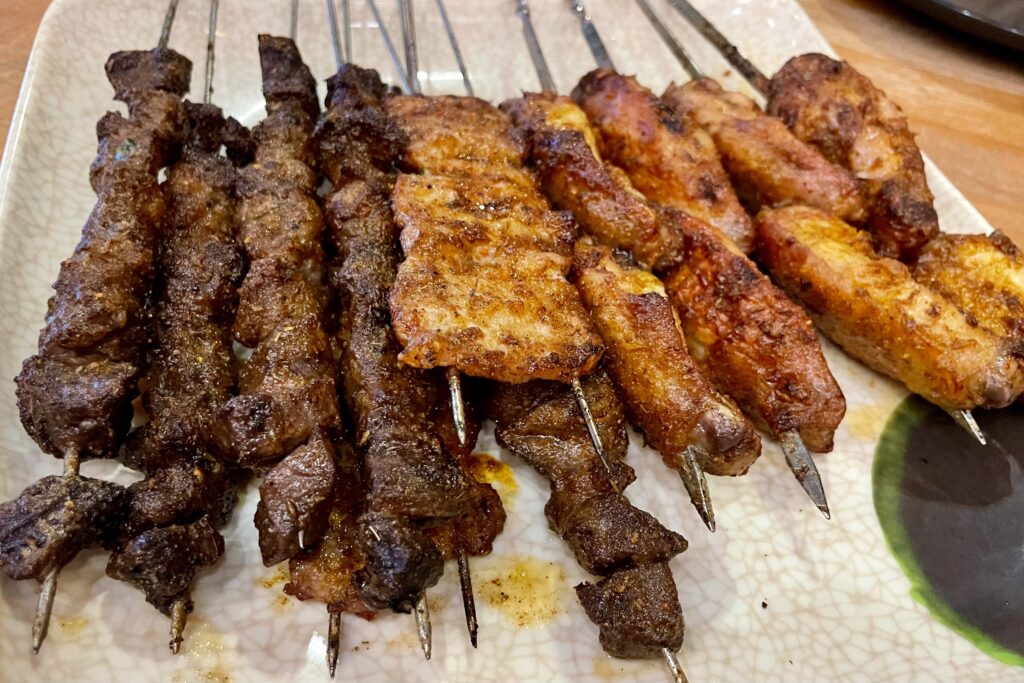
    Skewers are a must when it comes to Chinese street food. At Lingdian Chuanba, you’ll find an impressive array of options: meat, fish, seafood, vegetables, and more. The menu offers endless choices, and we’ve already tried a number of different skewers. From lamb and beef skewers to spicy and garlic chicken wings, lamb kidneys, beef tendons, chicken gizzards, pork belly, grilled octopus, oysters, mushrooms, tofu, Chinese chives, and bell peppers – the selection is so vast, I may have forgotten a few!

    Each skewer is crispy on the outside and wonderfully tender on the inside. Seasoned with cumin, chili, garlic, and a blend of spices, they develop a rich, savory flavor with a hint of smokiness. They also retain their unique character: aromatic fatty lamb, juicy chicken wings, nutty and earthy mushrooms with a meaty texture, robust lamb kidneys, chewy beef tendons, salty seafood, mild and soft tofu, and vegetables ranging from sweet to bitter. Alongside these skewers, you’ll find barbecue classics like scallops and oysters, which offer a smoky, intense and spicy flavor with a firm texture. We previously reported on a night market in Wuhan where oysters are prepared the traditional Chinese way, so feel free to check that out.

    If you’re looking for a hearty meal, you can choose from a variety of noodle dishes. There is a wide selection including rice noodles, glass noodles, and egg noodles, available with or without soup, and with various ingredients such as minced meat, beef, mushrooms, pak choi, beans, and more. Each bowl is served with a half-cooked egg, cilantro, green onions, and pickled radish in four separate small bowls.

    I’m a big fan of the noodle soup with braised beef (红烧牛肉, Hóngshāo Niúròu). The beef is slow-cooked in a savory sauce made from soy sauce, sugar, rice wine, ginger, garlic, and a mixture of spices, resulting in meat that is wonderfully juicy and tender. The pak choi stays crisp, the egg noodles are rich and slightly buttery, and the soup itself is hearty and umami, with a pleasant hint of heat from a touch of chili oil (optional, of course). The sugar in the sauce adds a subtle sweetness that balances the savory flavors nicely.

    I like to add the egg to the soup and stir it in, creating a mild, creamy contrast that enhances the intense flavors of the beef and broth. I also garnish with cilantro and green onions for a fresh kick. Occasionally, I also enjoy a bite of pickled radish to “cleanse” my palate (much like pickled ginger with sushi) and help me fully appreciate the diverse flavors of the noodles, skewers, and other dishes.

    We also recommend authentic noodle soup with minced meat and pickled beans, as well as Suan La Fen (glass noodles with pork in a sour and spicy soup).

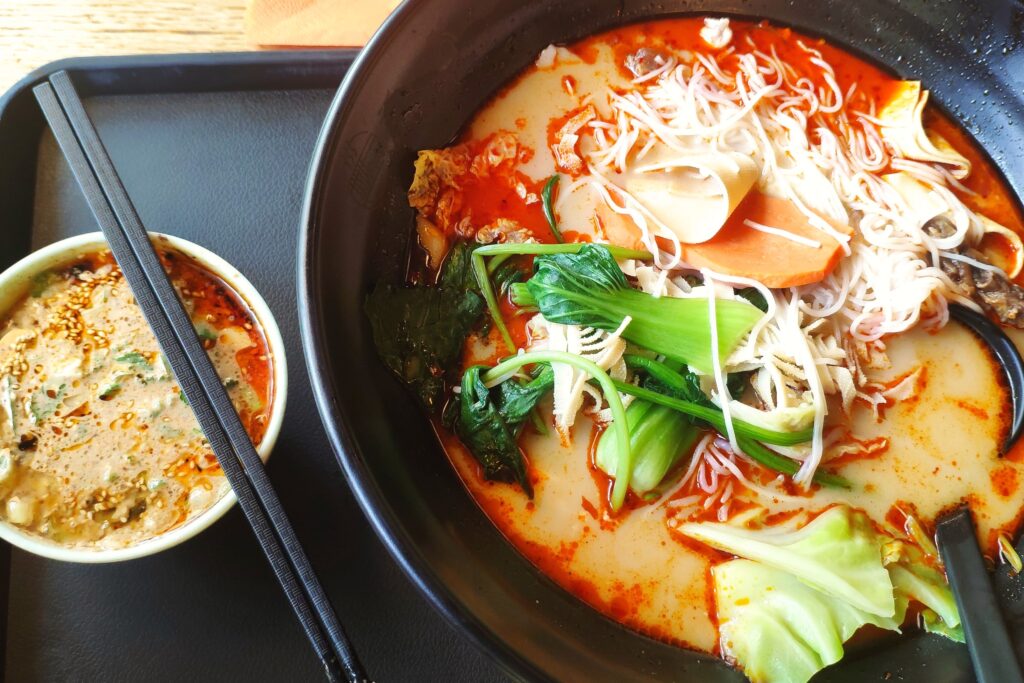
    Suan La Fen (酸辣粉), a specialty from Sichuan cuisine, translates to “sour and spicy noodles,” which perfectly captures its essence. This dish features smooth, elastic glass noodles, typically made from sweet potato starch, served in a flavorful broth. The broth showcases a balanced mix of sour, spicy, and slightly sweet flavors characteristic of Sichuan cuisine. Chinese black vinegar contributes a rich acidity, while chili oil and spicy Sichuan pepper provide the heat. Garlic, soy sauce, onions, and cilantro add a touch of sweetness and freshness. Minced pork enriches the dish with savory, umami notes, creating a well-rounded and satisfying experience.

    Noodle soup with minced meat and pickled beans, known as 酸豆角肉沫面 (Suan Dou Jiao Rou Mo Mian), is a fragrant dish from Sichuan province, known for its spicy cuisine. The main ingredients are fermented sour pickled green beans (酸豆角) and spicy stir-fried minced pork (肉沫) seasoned with garlic, ginger and chili paste. The thick, chewy wheat noodles absorb the rich flavors of the sauce, creating a perfect foundation for the intense heat of the Sichuan chili paste, the tangy acidity of the pickled beans, and the deep umami of the minced pork.

    If you’re in the mood for something dry, zhajiangmian is a perfect choice. This flavorful Chinese noodle dish features stir-fried minced pork infused with the deep umami of dark doubanjiang, a rich fermented bean paste.

    The julienned carrots and cucumbers on top deliver a refreshing crunch, nicely contrasting the savory sauce. Fresh cilantro and green onions on the side add an aromatic lift when mixed in, while pickled sour radish provides a tangy punch that balances the flavors. Half a soft-boiled egg on the side lets you mix the yolk with the noodles for a creamy richness. It’s an appetizing and versatile dish.

    In addition, Lingdian Chuanba offers a number of barbecue specialties that quickly catch the eye on the menu due to their presentation in aluminum containers. But what’s the reason? In Chinese cuisine, grilling in aluminum foil is a popular method that preserves the flavor and juiciness of ingredients through gentle, even cooking. This technique not only enhances the flavors, but is also ideal for preparing dishes quickly and effortlessly. Let me introduce you to some of these delicacies.

    Enoki mushrooms grilled in aluminum foil or 锡纸金针菇 (Xīzhǐ Jīnzhēnɡū) are known for their mild, slightly sweet flavor and crunchy texture. When combined with spices such as garlic, chili, and green onion, they become an aromatic and succulent dish that offers a delightful blend of savory, spicy, and umami flavors.

    Grilled Chinese cabbage wrapped in aluminum foil, known as 锡纸娃娃菜 (Xīzhī Wáwá Cài), has a tender texture and a mild, slightly sweet flavor. The small cabbage heads stay fresh and are seasoned with spices such as garlic, chili, scallions, and soy sauce, adding layers of depth to the flavor.

    Tofu grilled in aluminum foil, or 锡纸麻辣豆腐 (Xīzhǐ Málà Dòufu), delivers a robust flavor thanks to a spicy sauce made with Sichuan peppercorns, chili, garlic, ginger, soy sauce, and other spices. This combination creates a rich blend of heat, umami, a hint of sweetness and tender tofu. Fresh cilantro is added as a garnish, providing a refreshing contrast that completes the dish beautifully.

    If you’re still hungry afterward, consider ordering a plate of Chinese dumplings, or Jiaozi (饺子), which are a staple of any Chinese street food restaurant. Lingdian Chuan Ba may not have the best dumplings in town, but they’re still pretty tasty. If you’re a fan of Chinese dumplings, this place is worth a try.

    For food lovers looking to try something new, grilled pig’s feet, known in Chinese as 烤猪蹄 (Kǎo Zhūtí), is an excellent choice. This popular Chinese delicacy is first marinated in a flavorful blend of soy sauce, garlic, ginger, star anise, and Sichuan pepper before being grilled or fried. The result is a rich, spicy and subtly sweet flavor.

    Pig’s feet offer a savory and spicy flavor, with crispy skin and tender, juicy meat. The texture ranges from crunchy to slightly gelatinous, adding a unique depth to the dish. The blend of spices adds to the complexity, making it a distinctive and memorable dining experience.

    The tradition of Chinese midnight snacks thrives not only in China’s night markets, but also in the heart of Frankfurt. Língdiǎn Chuàn Ba brings a taste of this vibrant culture and its diverse flavors to the German city, offering hungry night owls an impressive array of authentic dishes. From crispy barbecue skewers to hearty noodle soups, there’s something for everyone to satisfy late-night cravings while sharing a slice of everyday Chinese life.

  • Unleash the Fiery Flavors of Sanku-Maotsai: Authentic Sichuan Maocai in Frankfurt

    Unleash the Fiery Flavors of Sanku-Maotsai: Authentic Sichuan Maocai in Frankfurt

    Contrary to what the name might suggest, the restaurant Sanku-Maotsai, located just a few minutes’ walk from Frankfurt main station, is not about Maotai or Moutai – a type of baijiu, a traditional Chinese liquor or schnapps. Instead, the name refers to a popular authentic Chinese dish called Maocai (冒菜) from Sichuan Province, known for its spicy and aromatic cuisine.

    Restaurant Profile

    All spices are imported directly from Sichuan to ensure an authentic taste experience. Look out for recurring discount promotions and free side dishes (like chicken feet to try – maybe not everyone’s cup of tea, but a unique experience😊).

    Vegetarians are also well catered for at Sanku-Maotsai, with a wide variety of vegetables, mushrooms, tofu, noodles and more.

    But what exactly is maocai? This dish is a combination of various ingredients such as meat, fish, seafood, tofu and vegetables cooked in a spicy broth or stir-fried, similar to the famous hotpot or malatang.

    Three words, three dishes, and it’s easy to get confused: hotpot, malatang, and maocai. Here’s a quick guide to clear up the confusion:

    • Hotpot (some excellent hotpot restaurants in Frankfurt, for example, are Liuyishou and Sen (vietnamese Version)) is an interactive experience where fresh, pre-selected ingredients are cooked together in a large pot – one of the absolute classics of Chinese cuisine.
    • Malatang (if you want to learn more about Malatang, you can find a restaurant in Frankfurt here) and Maocai differ from Hotpot mainly in that the ingredients are not cooked together in a broth at the table, but are already prepared in the kitchen and then served.
    • With maocai, the differences go a bit further, for example, different spices and sometimes Chinese medicinal herbs are used for the broth, and there is also a “dry” version.

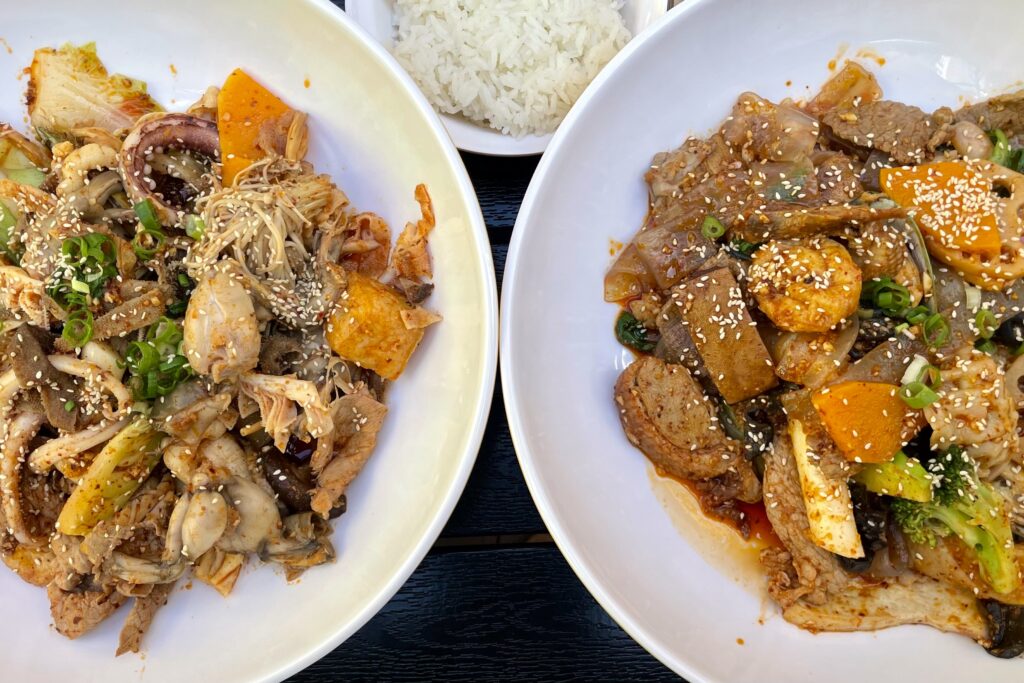
    For this restaurant, we want to focus on dry maocai (香辣干拌), which is made by briefly blanching the ingredients and then stir-frying them in a pan with hot sizzling oil, dried chilies, Sichuan peppercorns, garlic and ginger. Soy sauce, rice wine and a little sugar are added.

    Everything is mixed well and simmered briefly until the flavors are fully developed and the ingredients are cooked to perfection.

    Dry maocai is served hot and is characterized by its pronounced heat and the distinctive, slightly numbing “mala” sensation on the tongue caused by the chilies and Sichuan pepper. It also has a deep, savory umami flavor from the meat, soy sauce, and other flavor-enhancing ingredients.

    While ingredients cooked in a broth become tender, juicy, and aromatic, dry maocai retains the original texture of the components: vegetables remain crisp, and meat or seafood develops a firmer, often slightly caramelized surface. Dry Maocai has a more intense and concentrated flavor because the spices and seasonings adhere directly to the ingredients and are not diluted by a broth. It is this combination of bold flavors and varied textures that probably makes the dry version even better for me than the broth-based one …

    It is similar in taste to ma la xiang guo (such as what you find at the China Haus in Frankfurt) or gan guo, where the ingredients are also served in a spicy sauce with minimal liquid.

    If you still prefer the soups, here is an overview – the following broths are available:

    • Spicy soup – traditional Sichuan spicy (经典川味 – jīng diǎn chuān wèi)
    • Tomato soup, mild (浓香番茄 – nóng xiāng fān qié)
    • Sour soup with sauerkraut – spicy, but slightly milder than the spicy soup (老坛酸菜 – Lǎo tán suān cài)
    • Fresh soup with cooked mushrooms, mild (鲜香三鲜 – xiān xiāng sān xiān)

    If you are a regular reader of our blog, you are probably already familiar with the following process. Start by grabbing a bowl and tongs at the entrance, then head over to the food station and explore the wide array of ingredients. You’ll find everything a maocai lover could want. This includes various meats (some marinated, meat rolls, meatballs, etc.), seafood and fish, a variety of vegetables (broccoli, carrots, cabbage, pak choi, etc.), mushrooms, tofu, and several types of savory noodles. Fill your bowl with your favorites, then choose your preferred cooking method – we recommend the dry maocai. Alternatively, you can choose from the broths listed above. For a small surcharge of 2 euros per person, you can also order an unlimited rice option.

    After placing your order, you will receive a pager. While your maocai is being prepared, you can create your own dipping sauce at the sauce buffet – we’ve covered this in other posts (e.g. Liuyishou in Frankfurt or Haidilao in Wuhan). The base sauces are golden-brown peanut and sesame sauces. We recommend adding garlic, coriander, shallots, and a bit of chili (though you may want to skip the chili since the maocai is already hot). Feel free to experiment and adjust to your taste.

    Now that you have hopefully gotten a good impression of the delicious dishes, have fun trying them out and enjoy your meal at Sanku-Maotsai!

  • Thai Boat Noodles: A Taste of Authenticity, Tradition, and Nostalgia at Soi 22

    Thai Boat Noodles: A Taste of Authenticity, Tradition, and Nostalgia at Soi 22

    Step into the vibrant world of Thailand right here in Frankfurt at our latest culinary hotspot – Soi 22. This new Thai restaurant is a must-visit for anyone craving the true taste of Thailand. From the moment you walk in, you’ll be enveloped in the lively ambiance and charming decor that reflects an old tradition uniquely Thai – the boat noodles culture.

    The owner, passionate about bringing authentic Thai experience to Germany, has recreated the unique and historic tradition of “boat noodles” (Kuay Teow Reua). Originating from the Ayutthaya period (1351-1767), these noodles were once sold from boats along Thailand’s bustling canals, when canals were the primary means of transportation in many parts of Thailand. Vendors would paddle their boats along canals, preparing and selling bowls of noodles to people on the banks or other passing boats.

    With the decline of canal transport, boat noodle markets have made their way to land-based stalls and restaurants, evolving into vibrant cultural and recreational hubs. Soi 22 beautifully mimics this traditional flair with decor like barber shops and massage parlors, creating an atmosphere that transports you straight to a charming miniature version of a Thai boat noodle market.

    Restaurant Profile

    Before diving into the food, let’s introduce you to two indulgent yet refreshing Thai iced tea creations.

    Thai Ice Tea with Lemon, made from a blend of black tea and spices such as anise and tamarind, has a deep, ruby-red hue. The addition of a slice of lemon enhances its bright, lemony sweetness with a subtle tang.

    Thai Ice Tea with Milk offers the creamy, indulgent side of the Thai iced tea. The tea blend with spices gives it a deep amber color that remains visible at the bottom where it hasn’t been mixed fully with milk. It creates an appealing contrast of creamy white on top and rich golden tea below. A sprinkle of cinnamon on top adds a touch of warmth that complements its luscious, milky flavor.

    Though not meant for cooling the thirst, these sweet, refreshing treats are perfect for balancing the bold, spiced Thai flavors, making them a hit for those who love rich, dessert-like drinks.

    Soi 22’s carefully selected starters bring the authentic flavors of the Thai night market right to your table, featuring popular local snacks like crispy wontons and crispy pork fat. You won’t want to miss the A1 Grilled Pork Balls and A4 Steamed Spicy Prawn Wontons— the absolute must-try dishes at Soi 22.

    A1 Grilled Pork Balls features nine freshly handmade pork balls, served on three skewers and topped with cilantro and a slice of red bell pepper.

    Expertly crafted, the meat balls taste incredibly fresh and bouncy, offering a satisfyingly firm texture. The slightly charred surface adds a delightful chewiness and smoky flavor. Generously dip them in the sauce for a blend of smoky, tangy, sweet and subtly spicy notes. It wonderfully enriches the savory, umami-packed meat balls, adding tantalizing layers of taste to every bite!

    A4 Steamed Spicy Prawn Wontons is a dish that had the diner next to us exclaiming “seafood paradise!” And we wouldn’t disagree.

    This exquisite dish features three meticulously crafted wontons, each generously filled with two succulent black tiger prawns. Bathed in a dark, aromatic fish sauce and topped with cilantro and fresh chili, these wontons are a true taste sensation.

    Each wonton bursts with natural sweetness of juicy prawns, perfectly complemented by the bold spices. The delicate steamed wrapper is soft and slightly chewy, melting in your mouth and beautifully contrasting with the firm, plump prawns inside.

    The accompanying spicy, tangy, and slightly sweet fish sauce enhances the overall flavor. Be warned, the sauce packs quite a spicy punch, but it’s this heat that makes the dish so invigorating. Take a bite, and you’ll be hit with an exhilarating blend of textures and flavors—the tender prawn filling, the soft wonton wrapper, and the spicy, umami sauce.

    For those who find the spice level too intense, the sweet Thai drinks can be your remedy here. But trust us, every spicy, flavorful bite of these wontons is worth the heat. It’s truly a piece of seafood paradise.

    Now, let’s dive into the main event—Thai boat noodles! These come with a dark, luscious broth, known for its rich and intense flavors, thanks to a blend of spices, herbs, and sometimes even pig or cow blood for added depth and thickness. At Soi 22, they stick to tradition with a moderate portion of broth, just like in the old days when rickety boats were prone to spillage. But don’t worry— if you want more, you can get extra broth at no extra charge.

    For your noodle bowl, you can choose from a variety of ingredients, including tender beef, flavorful beef balls, and a selection of offal. Each dish is accompanied with Thai basil and crisp bean sprouts for a burst of freshness and crunch.

    You can enjoy your noodles with or without broth, and pick from egg noodles, thin or thick rice noodles.

    For an extra kick, you can add chili flakes, pickled sour chili, fish sauce, and sugar. The Thai chili flakes pack a serious punch, so sprinkle with caution!

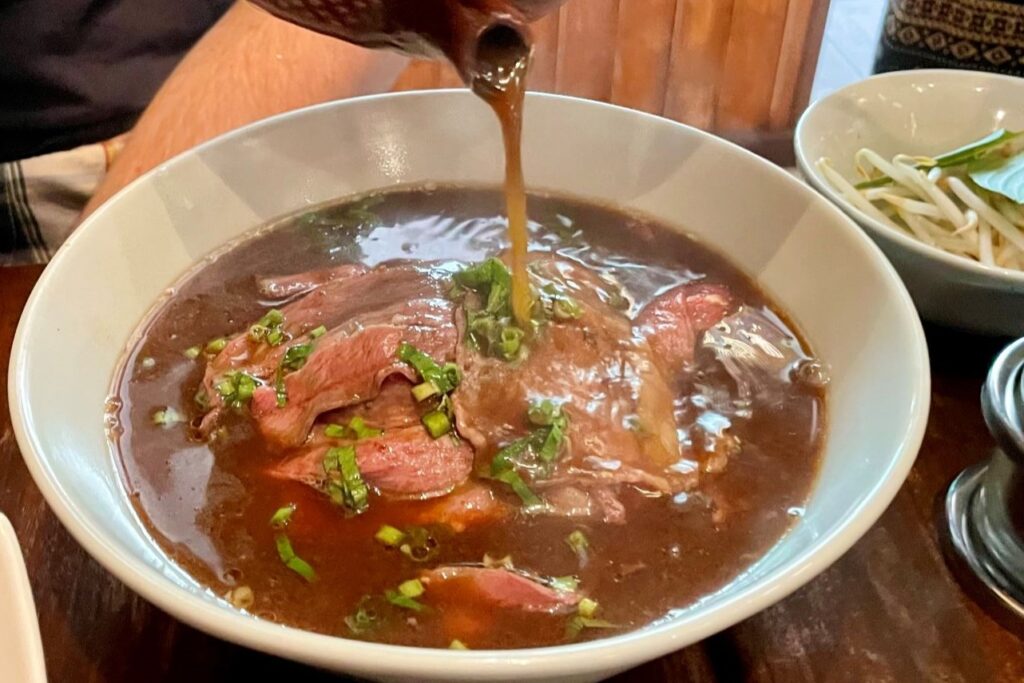
    N6. Nam Tok Wagyu A5 Sliced Wagyu takes Thai boat noodles to a whole new level. This dish features premium A5 Wagyu beef, sliced thinly and served raw, flaunting its rich marbling and vibrant red color. It’s a feast for the eyes and the palate, promising a succulent, beefy sensation.

    Generously layered over the noodles, the raw Wagyu is cooked right at your table. Watch in awe as the staff pours hot broth over the beef, transforming it into juicy tenderness right before your eyes. This theatrical cooking process ensures the Wagyu’s buttery richness is preserved at its freshest, elevating the dish to luxurious heights.

    The dark, robust broth, infused with a complex blend of spices, herbs, and a hint of tanginess, superbly complements the rich, savory Wagyu. Fresh Thai basil and crisp bean sprouts add a refreshing crunch and balance to the rich flavors.

    Be sure to stir the noodles right after adding the broth, as the thick, flavorful concoction can make the noodles mushy if left still for too long. Each mouthful delivers a tantalizing mix of tender beef, rich broth, and vibrant toppings — a lavish twist on traditional Thai boat noodles that is sure to impress.

    N5. Nam Tok All-In is the epitome of authentic Thai boat noodles, uniting a delectable assortment of beef components in one bowl. This dish features sliced beef, braised beef, beef balls, tendon, liver, and tripe, delivering a genuine taste of traditional Thai flavors.

    The rich, thick broth deepens the savory flavors of the tender sliced and braised beef, with the braised beef adding an extra layer of melt-in-your-mouth goodness. The beef balls are chewy, firm, and bursting with flavor. The tendon, soft and gelatinous, fully absorbs the richness of the broth. The liver offers a bold, earthy flavor that adds complexity, while the tripe is chewy and slightly spongy, providing a unique texture.

    Enjoy this dish with the robust broth and fresh veggie toppings like Thai basil and bean sprouts. Each spoonful is intensely flavorful, with a refreshing crunch and brightness that balances the rich savoriness.

    The variety of beef cuts are staples in classic Thai boat noodles, making it a top choice for those craving an authentic taste of Thailand.

    The only dessert offer at Soi 22 is the E1. Original Khanom Thuay, and it’s nothing short of extraordinary. This steamed coconut pudding has a smooth texture and a rich, layered flavor.

    Khanom Thuay consists of two layers: a silky, slightly salty coconut custard on top and a subtly sweet, steamed rice flour base below. The bottom layer is tender and smooth, while the top layer is luxuriously creamy, bursting with aromatic coconut flavor.

    Each bite blends sweet, savory, and creamy notes with a light, melt-in-your-mouth quality. For the best experience, use the bamboo spoon to gently scrape from the edges, ensuring you get both layers in every bite. This indulgent dessert will impeccably round off your meal at Soi 22.

    At the end of our meal, we were treated to a sweet surprise not listed on the menu: Palm Sugar, Milk, and Coconut Dessert, a complimentary goodie on the house. This dessert features a soft, cake-like base that’s lightly spongy and sweetened with palm sugar, giving it a warm, golden color and a rich, earthy sweetness.

    Crowned with shredded coconut, it lends an enjoyable chewiness and a hint of nutty flavor, highlighting the dessert’s subtle tropical notes. The coconut’s slightly fibrous texture contrasts nicely with the soft, airy base, combining the indulgent sweetness with a pleasantly light touch.

    The atmosphere at Soi 22 is infectious, as every guest seems to revel in delicious food and joyful mood. The staff greets every guest with traditional, heartfelt gestures—hands pressed together and a gentle “sawadika” (hello in Thai), a subtle bow that speaks volumes of their grace and humility. In quieter moments, the owner himself would take the time to chat, sharing stories about each dish, from its origins in Thailand to the influences from neighboring countries. His passion for the cuisine and the restaurant was palpable.

    Soi 22 is undoubtedly a taste of authentic Thai fare. More than that, it’s an immersion into a slice of Thailand’s soul, where simplicity and authenticity shine brightest, steeped in tradition, warmth and a sprinkle of nostalgia.

  • Ultimate Guide to Authentic Malatang Dining in Frankfurt’s City Center

    Ultimate Guide to Authentic Malatang Dining in Frankfurt’s City Center

    Today I’d like to introduce you to 香香麻辣烫 XiangXiang Malatang (Spicy Hotpot), a restaurant that has been a favourite of both Asians and locals in Frankfurt for years. Conveniently located in the heart of Frankfurt’s city centre, close to the Römer square in the old town, this place specialises in malatang, a popular dish from authentic Chinese cuisine, as the restaurant’s name suggests.

    Restaurant Profile
    • Name of the Restaurant: 香香麻辣烫 XiangXiang Malatang(Spicy Hot Pot)
    • Adress: Berliner Str. 64, 60311 Frankfurt am Main
    • Style: Chinese Cuisine
    • Price: around 15 – 25 EUR per Person (incl. Drinks and Tips)

    Before going into the details of this malatang restaurant, let me give you some background information: Malatang (麻辣烫) originates from the Sichuan region, known for its spicy and aromatic cuisine. The name ‘malatang’ is made up of the Chinese words ‘ma’ (麻) meaning ‘numbing’, ‘la’ (辣) meaning ‘spicy’ and ‘tang’ (烫) meaning ‘hot’ or ‘boiling’. It describes a hot soup that is both spicy and mildly numbing due to the use of Sichuan peppercorns and chilli. We have already introduced the concept of mala in previous articles (e.g. Höfchen Restaurant in Frankfurt, Zhuge Grillfish in Frankfurt or Seen in Munich).

    At XiangXiang Restaurant, the focus is on Dongbei malatang – a variation of malatang from the Dongbei (东北) region of northeast China, known for its unique culinary traditions. The main difference between Dongbei malatang and Sichuan malatang is the intensity of the heat and the specific spices used in the broth. Sichuan malatang is famous for its high level of spice and the distinctive taste of Sichuan pepper, while Dongbei malatang is generally milder and more accessible to many people, with an emphasis on savoury and umami flavours. In addition, Dongbei Malatang uses a seasoned sesame paste as a dipping sauce to add a creamy, nutty note and balance the spicy broth.

    Unlike the traditional hotpot, malatang is not eaten from a single large pot in the middle of the table; instead, each person has his or her own bowl. The great thing about this dish is that you can customise it to your liking.

    Here’s a quick DIY guide to get you started. Simply grab a bowl at the entrance and a pair of tongs to fill your bowl with some of the ingredients from the large bar. Your chosen ingredients will then be cooked by the kitchen staff in a broth of your choice and served to you.

    Let’s start with your soup ingredients. You have a wide range of vegetables to choose from, including bok choy, spinach, broccoli and bean sprouts. Consider adding mushrooms, such as champignons and the wood ear mushrooms, which are very popular in China. Include different types of tofu, a variety of noodles, fried eggs and dumplings. For protein, you can choose from a range of meats – cured, sliced or in the form of meatballs – and seafood options such as prawns and squid. There are also many other delicious options to choose from.

    The choice is truly vast, with over 10 different types of noodles alone. Take your time to look at everything carefully, then use the tongs to place your chosen ingredients in your bowl.

    There’s no one ingredient that stands out from the rest – it’s all about personal taste. However, we suggest focusing on fresh ingredients and creating a vibrant variety of flavours. Start with your choice of noodles as the base, then add vegetables, mushrooms and tofu, meat (especially meat rolls, which are very popular with Asians) and perhaps some seafood, depending on your taste.

    Once your bowls are filled to your satisfaction (note: sometimes we tend to overestimate our appetites, so choose your favourite ingredients wisely), feel free to grab a drink from the fridge and take your bowl to the reception area. Here you’ll be asked to choose your soup base from the following options:

    • A spicy red chilli base (Mala 麻辣) with Sichuan pepper and chillies – a timeless classic,
    • A highly spicy broth with green Sichuan pepper (藤椒 Teng Jiao), known for its fresh, citrusy notes, different from the red Sichuan pepper found in the Mala broth,
    • Tomato broth (番茄 Fan Qie), which offers a subtle blend of sourness and sweetness,
    • Gentle beef broth (骨汤 Gu Tang), made from beef bones and simmered for a long time – the basic choice,
    • Hot and sour broth (金汤 Jin Tang), known as ‘golden broth’ for its bright yellow colour,
    • And finally, Spicy Lemon Broth (柠檬金汤 Ning Meng Jin Tang), a variation on the golden broth, infused with lemon for a refreshing twist.

    With each of these broths, you can adjust the spice level to your liking. If you like a particular broth but want it to be milder, simply order it with less spice.

    Once you’ve chosen your broth, you’ll be given a numbered token. Above the ingredient station you’ll see a numbered board. When your soup is ready, your number will be announced. Just a heads up: The announcements are in Chinese, so if you don’t understand, just check the board for your number.

    While you’re waiting for your soup, you can start making your dipping sauce. It’s the same method as for hot pot (see one of our previous blog posts for detailed instructions). For dongbei malatang, the basic element of the dipping sauce is sesame paste. Spring onions, garlic and perhaps some spices may be added. We prefer a traditional mix of sesame paste, coriander, spring onions, garlic, cumin and a touch of chilli oil. As dips can be made fresh for any occasion, we encourage you to explore different combinations to find your perfect blend.

    Once your number has been called, please proceed to the counter to collect your freshly prepared malatang. You will be given a deep spoon for the soup and a pair of chopsticks to enjoy the ingredients. Dip each ingredient from your bowl into the dipping sauce you have prepared, but be careful as some broths are very spicy.

    Malatang is all about variety and flexibility, allowing you to choose from a wide range of ingredients and customise your bowl. The distinctive, flavourful broths are created by blending spices such as Sichuan pepper and chilli, ensuring every bite is uniquely delicious.

    The soups are quick to prepare, the ingredients are healthy and the meal is a social experience with friends and other guests.

  • A Flavorful Sequel: Continued Magic from Höfchen’s Sichuan Kitchen

    A Flavorful Sequel: Continued Magic from Höfchen’s Sichuan Kitchen

    In our previous posts, we may have teased your taste buds with a glimpse into the spicy world of authentic Sichuan food at Höfchen Restaurant in Frankfurt. Known as one of the flagship Sichuan restaurants in Frankfurt, this place offers a dazzling array of Sichuan dishes that go far beyond what we’ve showcased so far.

    Sichuan cuisine, one of China’s four major culinary traditions, is celebrated for its bold, spicy, and numbing flavors, as well as its impressive array of cooking techniques. It typically uses wild and foraged ingredients from the mountains, fresh seafood, and vibrant vegetables, all seasoned with the likes of Sichuan peppercorns, chilies, fermented bean paste (or 豆瓣酱), and fermented tofu (or 腐乳). With over 40 cooking methods, from sizzling stir-fries to oil-soaked crispy fries, the flavors are anything but ordinary.

    Today, we’re diving back into this thrilling and mouth-watering world, ready to embark on a sequel of taste adventure that’s both exotic and irresistibly delicious!

    Restaurant Profile

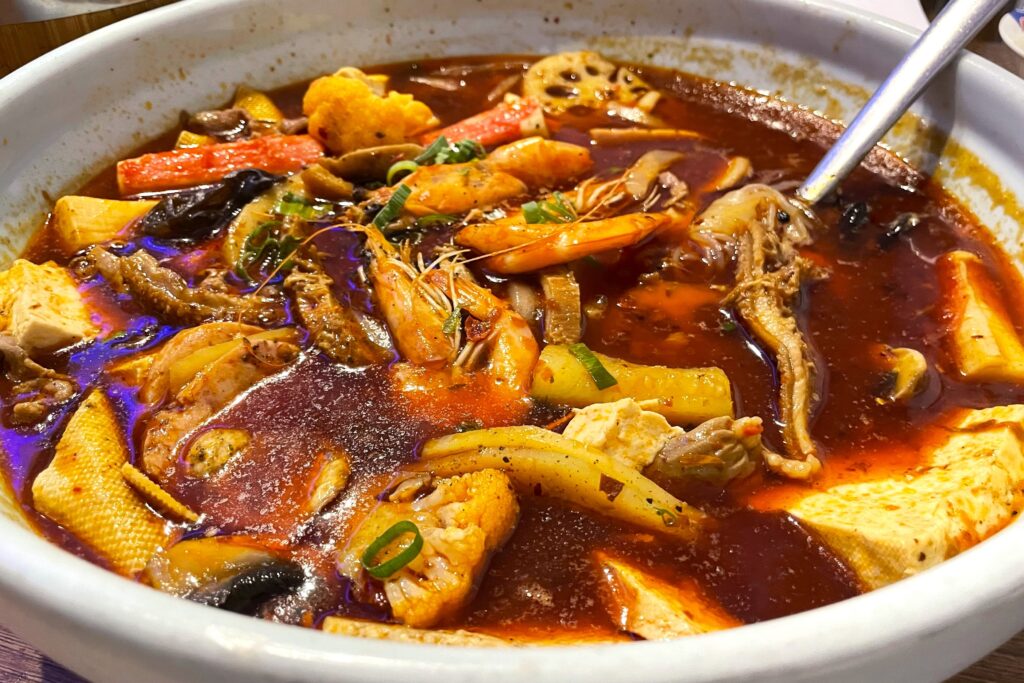
    Mao Cai (冒菜 or Chengdu Fondue) is a beloved dish originating from Sichuan with a rich history dating back to the Late Han Dynasty (mid-2nd century CE to 220 CE) and the Three Kingdoms period (220 to 280 CE). By the Western Han era (206 BC to 9 AD, Sichuan cuisine had already begun to take shape, thanks to the widespread use of well salt, which fostered a local preference for bold and spicy flavors.

    In the “Ode to Shu” by Western Jin poet Zuo Si, there is a mention of “调夫五味” (adjusting the five flavors), highlighting the use of medicinal herbs for seasoning. During the late Eastern Han Dynasty, constant warfare brought various illnesses to the troops, which reduced their appetite. Military doctors, to prevent disease spread and stimulate the soldiers’ appetites, instructed cooks to add medicinal herbs to their dishes. These herbs not only provided therapeutic benefits, but also enhanced the flavors. Over time, the cooks discovered that blanching various vegetables with these herb-infused broths resulted in tastier dishes that became favorites among the soldiers. This method of cooking, known as “Mao Cai,” spread throughout the military.

    When these military cooks retired and returned to civilian life, they took this cooking method with them and opened “Mao Cai” restaurants, which quickly became popular and led to an era of unprecedented prosperity for Mao Cai.

    Today, Mao Cai is enjoyed across China, with regional variations to suit local tastes. There are different styles, such as hot pot Mao Cai, clear broth Mao Cai, mildly spicy Mao Cai, and vine pepper Mao Cai. At Höfchen, the Mao Cai leans towards the hot pot style, essentially offering a personal hot pot experience.

    The broth is prepared using dozens of harmless medicinal herbs, combined with secret seasonings and common spices like dried chilies, Sichuan peppercorns, fermented bean paste (豆瓣酱), star anise, fennel, and sugar. These ingredients are stir-fried over low heat until the oil turns red, then deglazed with cooking wine and water to create a rich, flavorful base.

    Various ingredients such as potato slices, lotus root slices, cauliflower, konjac noodles, tofu, wood ear mushrooms, potato noodles, mushrooms, tripe, pork belly, luncheon meat, crab sticks, shrimp, and tender beef are added to this broth, absorbing its deep flavors. Finally, it is finished with a drizzle of red oil, salt, chopped green onions, minced garlic, and sesame oil.

    Mao Cai is characterized by its spicy, numbing, and aromatic qualities that awaken the taste buds. The spicy flavor is the soul of Mao Cai, enhancing aroma, reducing greasiness, masking off-flavors, stimulating appetite, dispelling dampness, and warming the body. The ingredients themselves, whether meat or vegetables, release their natural flavors during cooking, making the dish both satisfying and appetizing. The broth, while flavorful, is generally not consumed on its own.

    Mao Cai is probably one of the most representative dishes from the exotic and irresistibly delicious world of Sichuan cuisine.

    Originally a signature dish from Xinjiang, Lamb Meat with Cumin (孜然羊肉 or Lammfleisch mit Kreuzkümmel) has made its mark in Sichuan cuisine circles. Perhaps it’s the fiery flair of cumin perfectly matching the zest of Sichuan flavors that has made it a hit among Sichuan cuisine lovers.

    Cumin boasts a unique oily richness and a strong fragrance that adds depth to dishes. Its earthy, warm, and spicy aroma not only masks the gaminess of lamb, but also highlights its natural clean, slightly sweet freshness, creating a perfect balance. This paring has thus become one of the best ways to prepare lamb in the region.

    Made from succulent lamb shank, cooked with fresh cilantro leaves and an array of spices, Höfchen’s method brings out the natural succulence of the lamb. Each bite evokes the sensation of savoring grilled skewers—slightly charred on the outside, yet juicy and plump on the inside. Covered in rich cumin and chili, every mouthful bursts with flavorful tenderness and enticing aroma that’s almost addictive!

    Pork Belly in Chili Garlic Sauce (Schweinbauch in Chili-Knoblauch Sauce or 蒜泥白肉) is a classic Sichuan dish. It features boiled, thinly sliced pork belly, ensembled with crisp cucumber slices, all dressed in a flavorful mix of soy sauce, chili oil, vinegar, sesame oil, a touch of sugar, and a fresh, fragrant garlic paste.

    As soon as the dish arrives, the tantalizing aroma of Mala (numbing) spice and fresh garlic hits you head-on. The pork belly itself is very succulent and juicy. Boiled in clear water with skin on, it takes on a rich and glossy appearance. Cut evenly, each slice curves delicately after cooking. Thanks to the fine balance of lean and fat, the meat has a tender, non-greasy texture.

    The sauce beautifully enhances the natural richness of the pork belly, delivering a mouthwatering blend of spicy, tangy, and garlicky flavors, finished with a hint of sweetness. Pair the soft, juicy pork with fresh, crunchy cucumbers to keep the dish light, refreshing, and utterly indulgent.

    Sichuan-Style Sauerkraut with Steamed Lotus-Leaf Buns (Sauerkraut nach Sichuan-Art mit Dampfnudeln in Lotusblatt-Form or 芽菜鸭米荷叶夹) features tender, flavorful duck meat combined with pickled mustard greens (芽菜) and served with soft, steamed buns shaped like lotus leaves.

    This dish is known for its harmonious blend of flavors and textures. The small, chopped pieces of duck meat are tender and juicy, infused with the sour savoriness of the region’s famous pickled mustard greens. Each bite bursts with tangy, umami-rich, deep flavors, perfectly complemented by the subtle heat of chili peppers and the aromatic note of shallots.

    Accompanying this flavorful mix are the steamed lotus leaf buns (荷叶饼). These fermented buns, often referred to as the “universal bun”, are soft, pillowy, and incredibly versatile. Their mild texture makes them the perfect vessel for all kinds of savory fillings. Simply tuck the savory duck and tangy pickled mustard greens mixture into the buns, and take a generous bite that’s soothing, flavorful, and fully satisfying.

    水煮牛肉 (Water-Cooked Beef in Chili Oil or Rindfleisch in Chiliöl) is an iconic Sichuan dish that embodies the essence of Sichuan’s fiery flavors. At first glance, this dish may seem intimidating, as it’s abundantly adorned with dry chili peppers, earning it a reputation as one of the spiciest in Sichuan cuisine. Beneath the sea of chili lies the tender, flavorful beef and crisp veggies like bean sprouts.

    Looking rich and luscious, each slice is covered with chili oil that glistens invitingly. It doesn’t taste greasy, but delicately oily and very appetizing. Not fried, but gently poached, the beef remains tender and juicy with a smooth and silky texture. Enhanced by the generous use of dry chilies and Sichuan peppercorns, the beef boasts a robust, spicy flavor that elevates its natural hearty richness. The intense aroma and fiery sensation evoke the spirit of Sichuan hotpot, while the bean sprouts offer a refreshing crunch that helps balance the heat.

    干煸四季豆 (Dry-Fried Green Beans or Gebratene Grüne Bohnen) is a flavor-packed Sichuan classic. The green beans themselves offer a slightly sweet and fresh taste, with a juicy interior encased in a crisp, slightly chewy exterior. Being deep-fried, each bean segment has a mild, smoky flavor and a distinctive wrinkled appearance.

    The seasoning of minced garlic, ginger, and Sichuan peppercorns imparts an aromatic and slightly numbing spiciness, characteristic of Sichuan cuisine. The dried chili peppers lend a fiery kick, while soy sauce and a touch of sugar balance the heat with savory, subtly sweet undertones.

    While usually prepared with minced meat for added umami richness, you can easily ask for a vegetarian version from the kitchen. Even without meat, the spices and seasonings ensure the dish remains robust and satisfying.

    鱼香茄盒 (Auberginetasche Gefüllt mit Schweinehackfleisch in Süß-Saurer Soße or Eggplant Pocket filled with Minced Pork in Sweet and Sour Sauce) is a renowned delicacy in Sichuan cuisine.

    At the heart of this dish are soft eggplants, bursting with juicy freshness, sandwiching minced pork fillings. They’re wrapped in a thin, translucent batter made from egg whites, and then deep-fried until the outside turns into a golden crust.

    It’s not a fish dish, but it has the taste of a simmering fish. This iconic 鱼香 (fish fragrant) flavor is achieved by weaving together the tang of pickled peppers, the subtle heat of ginger, and the sourness of vinegar.

    Seasoned with shallots, chili peppers, and red pickled peppers, each mouthful is an appetizing blend of pickled sourness, subtle sweetness, and a hint of garlic and spice that is sure to awaken the senses. Sink your teeth into the crip eggplant pocket and you’ll reach the savory, umami goodness of the juicy pork. Crafted from carefully selected lean and fatty cuts, the fillings are moist and incredibly rich in flavors!

    Bingfen (or 冰粉) is a Chinese dessert loved by many locals.

    While we’ve covered bingfen in our previous posts, the bingfen served at Höfchen deserves a special mention. Unlike in China, the bingfen here has a slightly thicker jelly consistency that provides a more solid mouthfeel. Served cold and decorated with various toppings like sesame seeds, date pieces, goji berries (枸杞), and hawthorn (山楂), each spoonful delivers vibrant, refreshing flavors – tangy sweetness, bright tartness, slight nuttiness, and chewiness from the dry dates. It’s a perfect treat for cooling down after a fiery Sichuan feast or simply on a hot summer day.

    Sichuan cuisine is said to have “a hundred flavors and a hundred dishes.” It brings together irresistible tastes like numbing spice, peppery heat, and fish fragrant flavors. Today, we’ve delved into some of the iconic dishes to experience their charm. But our journey doesn’t end here; we’re eager to dig deeper and uncover more authentic flavors cherished in local households or in mountain villages and fields. If you’re intrigued, stay tuned for more posts featuring diverse, adventurous, spicy, and tantalizing dishes.

  • Taste the Tradition at LeDu: Uncovering Bonn’s Authentic Chinese Street Eats

    Taste the Tradition at LeDu: Uncovering Bonn’s Authentic Chinese Street Eats

    Hey there, fellow foodies! After our discovery of an exquisite Korean restaurant in the heart of Bonn, we were itching to explore more of the diverse flavors this city has to offer. Little did we know, tucked within the depth of a subway station lies a humble Chinese street food eatery. From the crispy goodness of Jianbing (Chinese pancake), to homemade dumplings with tantalizing, customizable fillings, to mouthwatering noodles, this spot teems with an array of deliciousness at wallet-friendly prices!

    Restaurant Profile

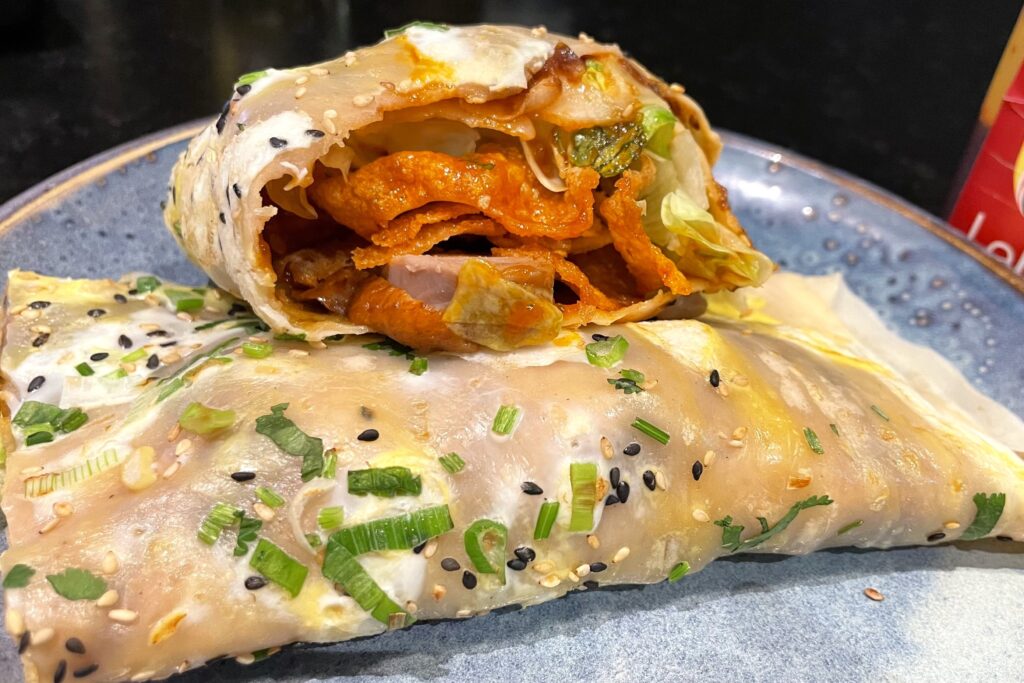
    One spotlight shines on Jianbing – the Chinese pancake, a beloved street food classic.

    Where there are woks, there are pancakes. The origins of pancakes can be traced back to the emergence of pancake griddles. Archaeological discoveries have unearthed ancient woks and griddles (鏊 in Chinese, pronounced “ao”), including prehistoric pottery woks dating back over 5000 years, as well as iron and copper woks from the Liao, Song, Jin, Western Xia, and Yuan dynasties. This indicates that the origin of pancakes dates back to at least 5000 years ago.

    Rooted in history, this traditional delicacy is made from a batter of mixed grains delicately spread thin and cooked on a griddle. Known for its use of coarse grains, Jianbing is celebrated not only for its irresistible taste but also for its nutritional richness, making it a beloved choice among locals.

    LeDu’s rendition of Jianbing pays homage to Tianjin’s famous Jianbing Guozi, a prominent representative among the diverse variety found across China. It begins with a thin, savory pancake made mainly from mung bean flour dough, topped with a cracked egg, scallions, sesame seeds, and a medley of customizable sauces – from Hoisin sauce, to peanut sauce, to garlic sauce – all at tailored spice levels. The pancake is then rolled up and wrapped around thin slices of crispy crackers and various fillings at your choice, such as Peking duck, beef, pork, or tofu, along with fresh lettuce and other toppings.

    Mix and match the fillings and sauces to your heart’s content. From smooth, nutty peanut sauce to aromatic garlic, to alluring homemade chili sauce, each adds a unique delectable touch, whether paired with succulent Peking duck, savory beef, tender pork, or wholesome tofu.

    However, if we may make a recommendation: Peking duck with Hoisin sauce is a classic match, steeped in tradition. As highlighted in a previous post, Peking duck, a revered Chinese national dish, finds its perfect companion in the thick, savory, slightly sweet Hoisin sauce. The succulent meat and delicately crispy duck skin are elevated by the luxurious richness of the sauce, while the crisp lettuce provides a refreshing contrast. Together with the crunchy cracker, everything is enrobed by the fragrant, pillowy pancake, resulting in a hearty, dynamic, and savory burst of flavors in each mouthful.

    Hot Pot Bowl (麻辣烫 or Ma La Tang) is a fiery masterpiece hailing from Sichuan, China, specifically the city of Leshan. It features a bubbling cauldron of rich, aromatic broth, infused with numbing Sichuan peppercorns, fiery chili peppers, and an exotic blend of spices.

    As it reaches a boil, various ingredients – from plump shrimp, tender beef balls, springy beef tripes and airy tofu puffs, to umami fish tofu, sweet-potato noodles, and crunchy lotus root – are added and cooked swiftly, to take on the bold flavors while keeping their natural freshness. And let’s not forget the seasonal vegetables like pak choy, earthy wood-ear mushrooms that lend vibrant color and texture to the mix.

    The Ma La Tang at LeDu emphasizes a rich, intense flavor that is felt primarily from the soup. It has an enticing look, and rich, aromatic smell. With a distinctive umami kick and a hint of indulgent oiliness, each ingredient cooked within really ignites your senses.

    Top it off with a sprinkle of crushed peanuts, a dollop of creamy sesame paste, and a shower of freshly chopped scallions. As you take your first bite, the heat creeps up on you, leaving your taste buds tingling with excitement. Amidst the savory sensation, you’ll find a subtle sweetness and a touch of sourness that brings brightness and balance to each slurp.

    Wan Tan Bowl from Chongqing (also known as 红油抄手 or Hong You Chao Shou) features firm, hearty wantons enveloping a filling of minced pork, tender shrimp, and just the right amount of fatty pork for an irresistible richness and smoothness.

    The meat and seafood medley, seasoned with soy sauce, rice wine, and fragrant sesame oil, is incredibly flavorful, especially when combined with the light sweetness and brininess of the shrimp. The broth, mainly flavored with fragrant sesame oil and aromatic chili oil, is further enriched by the natural savoriness of the pork and shrimp released from the cooking. Topped with fresh cucumbers, crisp carrots, pungent shallots, and crushed peanuts, each bite is packed with diverse flavor and texture!

    As a foreign friend once wisely said, to grasp China’s culture, better start with its street foods. They usually come from small shops, carts, and humble stalls along the streets, served in small portions, perfect for eating while strolling around. Each street food vender has their own specialties, a skill often practiced for life.

    For many locals, these street snacks not only evoke fond memories, but are also nostalgic delicacies marking the years of childhood, adolescence, to adulthood. Their flavors easily bring to mind kind, wrinkled faces, rough yet hearty hands, and steaming, aromatic dishes served by them. They speak volumes of unadorned warmth of life from the most ordinary corners of everyday life and the profound humanistic power behind.

    Just as a local food journalist expressed – it’s the taste of salt, the mountains, the sunlight, the morning’s zest, and the lingering warmth of life passing. These flavors blend through ages long, with homeland nostalgia, kinship, the virtues of thrift, resilience and faith, reflecting the people’s spirit and sentiment in the simplest yet most grandiose way.

  • Liu Yi Shou Hotpot: Indulge in Sichuan’s Flavor Extravaganza in Frankfurt

    Liu Yi Shou Hotpot: Indulge in Sichuan’s Flavor Extravaganza in Frankfurt

    Welcome back, fellow foodies, as we’re about to embark on a hotpot adventure at Liu Yi Shou Hot Pot restaurant in Frankfurt. When I first scrolled through some online snaps of this place, I’ll admit I had my doubts. I thought it’d just be another pricey spot with frozen, pre-packed meat rolls. Yet, I was wrong.

    You see, for a true hotpot experience, freshness is the key. With a short cooking time, you need fresh ingredients to keep their juicy, natural flavors intact. But if they’re not fresh? Well, you’re most likely in for tough bites drowned in overpowering sauces.

    After a few locals insisted we try Liu Yi Shou, we gave in – and thank God we did! With an array of hand-cut, fresh ingredients prepared just like back in China, Liu Yi Shou totally dazzled us.

    Restaurant Profile

    For anyone unfamiliar with hotpot, it’s a communal way of dining where a variety of raw ingredients are cooked in a simmering broth at the center of the table.

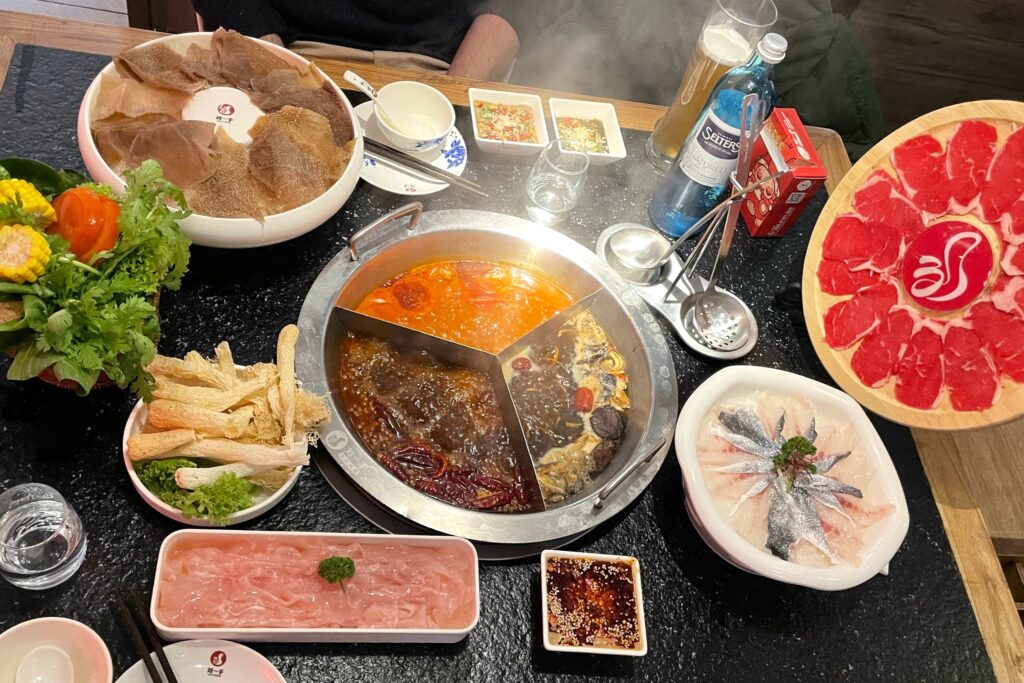
    At Liu Yi Shou, you can choose from different broths or soup basesOriginal Spicy (with 3 levels of spiciness), Tomato Beef, Pork Bone, Mixed Wild Mushrooms, Taiwan Satay (savory and slightly sweet), Corn and Pork Rib, Pickled Pepper and Vegetables. Don’t worry if you can’t handle the heat – most of the options are mild and non-spicy, except for the Original Spicy and Pickled Pepper Broth.   

    The real authentic Sichuan hotpot usually has a fiery, aromatic broth at the forefront. At its heart is the signature spicy beef tallow base. Crafted with the finest beef tallow, infused with chili peppers, peppercorns, fragrant fennel and more, this signature broth is revered for its bold and complex flavors. It’s both numbingly spicy and deeply savory.

    As the steaming pot of red oil broth is brought to the table, its tantalizing aroma is almost intoxicating. For those seeking true Sichuan flavors, the Original Spicy broth is a must.

    Liu Yi Shou also offers a 3-soup base combo at no extra cost, so you can sample different broths. And if you’re dining solo, they’ve got you covered with smaller pots, 2-soup combos, and even vegan soup bases!

    For our selection, we opted for the 3-soup combo: the Original Spicy, Tomato Beef, and Mixed Wild Mushrooms.

    The tomato broth is made with visibly plump, juicy tomatoes, simmered for hours before serving. It’s sour, slightly sweet, very fresh, and blended with the rich beef flavors – very appetizing!

    The mushroom broth is simmered with various species of wild mushrooms like boletus auripes, along with Chinese dates, goji berries, highly regarded for their nutritious benefits. What stands out about this broth is its light, fresh deliciousness, achieved without any added oils. It effortlessly brings out the natural flavors of the ingredients. When used to cook fresh vegetables like spinach or bok choy, the result is exceptional – a beautiful balance of sweetness and freshness that’s simply irresistible.

    Along with our versatile hotpot broths, we picked an enticing selection of ingredients – from tender hand-cut beef to fresh fish cuts, goose intestines, marinated beef cuts, homemade fish balls garnished with caviar, to freshly crafted coriander meatballs, beef omasum(cow’s stomach lining), vibrant vegetables mixes and bamboo mushrooms.

    Each main table is equipped with a convenient side shelf, perfect for storing dishes that you can’t fit on the table or don’t need right away.

    Adding to our dining joy is “Xiao Yao”, a cheerful robotic server who brought each dish to our table with a cute, sweet smile.

    While waiting for the main dishes, you can have a look at their side bar featuring appetizers like Kimchi, and desserts such as fresh fruits, all on the house.

    For a wholesome hotpot experience, dipping sauce is an absolute must! Liu Yi Shou offers a plenty of customization options, just like in the popular hotpot restaurants Hai Di Lao and Jin Ri Niu Shi in China. Just let your creativity run wild and craft your favorite flavor blend!

    As devout hotpot lovers, let us share some of our to-go combinations, tailored to complement different broths and ingredients:

    Meat Dipping Sauce: Sesame sauce, crushed peanuts, chopped scallions, garlic paste, chili oil, a spoonful each of soy sauce and vinegar, with a sprinkle of white sugar. The combination of rich sesame and crunchy peanuts, spiced up by chili oil, enhances the hearty meatiness to a sublime level!

    Garlic Oil Dipping Sauce: Garlic paste, small red chili peppers, coriander, chopped scallions, a spoonful of sesame oil, and two spoonfuls of soy sauce. Bursting with garlic aroma and a hint of spice, it’s a garlic lover’s dream.

    Seafood Dipping Sauce: Small red chili peppers, garlic paste, coriander, chopped scallions, chili sauce, a spoonful of oyster sauce, two spoonfuls of soy sauce, and a dash of vinegar. Take your seafood and fish dishes to new heights with this sauce that enhances their exquisite briny flavors.

    Clear Soup Sauce: Garlic paste, coriander, chopped scallions, chili powder, a spoonful each of soy sauce and oyster sauce, and two spoonfuls of sesame oil. If you prefer a lighter touch, don’t overlook this sauce. Perfect for clear broths like the mixed mushroom broth.

    Without further ado, let’s fire up the pot and start sizzling!

    Much of what we ordered are fit for all 3 broths:

    Their signature Hand-cut Fresh Beef needs just a brief dip in the boiling broth (about a minute) and undergoes unique flavor transformations when cooked in different broths.

    Immersed in the fiery, aromatic Original Spicy broth, each slice absorbs the bold and complex essence of the spicy beef tallow and Sichuan peppercorn, creating a mouthwatering tingling sensation with every bite! Paired with the meat dipping sauce and its luscious nutty sesame paste, it’s tender, juicy and packed with flavors!

    Simmered in the tomato sauce, the succulent beef takes on a sour and fresh note, with its meaty flavor nicely complemented by the bright and appetizing tang of the tomatoes.

    The mushroom broth imparts a light, delicate freshness. The beef’s earthy richness is perfectly balanced by the freshness of the mushrooms and herbs.

    Coriander meat-ball, shrimp balls, and fish filets go well with all 3 broths. Whether tingling with numbing spiciness or basking in the sour, refreshing tomato broth, each bite delivers a fusion of freshness and flavor. Personally, I’ve found that the shrimp balls and fish filet truly shine when paired with the light, fresh deliciousness of the mushroom broth.

    The Handmade Coriander Meat-Balls need around 10 – 20 mins to cook. Even when cooked longer, they remain remarkably soft and tender, while the distinctive earthy aroma of the coriander adds an uplifting freshness.

    The boneless Fresh Sea Bass Filets require around 2-5 min cooking time. Spicy broths or long exposure to high heat can make the fish dry. Milder broths help preserve its tenderness and natural delicate flavor, while adding a gentle savoriness.

    Handmade Shrimp Paste with Fried Chinese Doughut (油条) topped with Caviar benefits from mild broths too, where its delicate texture is best preserved. Cooking in fiery, spicy broth may make them soggy. Simply let them simmer for 5-10 minutes to unlock the subtle sweetness of the shrimp paste, savoriness of the fried doughnut, and briny richness of the caviar in full splendor.

    We find goose intestines, pepper beef and cow stomach taste the best, when paired with the rich Original Spicy broth.

    Double Pepper Beef offers an enticing blend of spice and succulence. Hand-cut from lean, tender beef, it’s adorned with fresh raw eggs, vibrant red and green peppers, and a medley of spices. Before dipping it in, gently mix them with eggs and chopped peppers and let the flavors blend. This egg coating not only ensures flavors distribute evenly but also locks in moisture, keeping the beef tender throughout the cooking (around 5 – 10 min).

    When we talk about the heart and soul of Chongqing hotpot, we can’t leave out the offal. So, let us introduce you to two beginner-friendly offal options that rarely disappoint.

    The Chilled Goose Intestines have a glistening and translucent appearance, a true sign of their freshness. To ensure their delectable taste, they undergo meticulous cleaning, with the walls scrubbed over a dozen times, then hand-rubbed with salt, white vinegar, and cornstarch before being thoroughly rinsed with water. They’re preserved in ice water to maintain their crisp and tender texture. After a 1-2 min dip in the hotpot, they emerge slightly rolled-up, delightfully crunchy, and irresistibly chewy!

    Black Beef Tripe (cow’s stomach lining) – different breeds of cattle offer unique flavors in their tripe – generally speaking, it tastes tender, crispy and slightly chewy. Liu Yi Shou’s tripes are thin yet robust, with a satisfying crunch and bounce. In just 10 – 20 seconds, it’s cooked ready, emerging from the aromatic fiery red broth. Dip it swiftly in the garlicky, spicy, sesame sauce to enhance its freshness. Let the rounded, erect spines glide over your taste buds, and savor the unparalleled crispness!

    Bamboo Mushroom and Vegetable Platter are better for the mild broths, as their porous texture could easily sock up too much heat in the Original Spicy broth. The rich tangy tomato broth and the light soothing mushroom broth impart subtle flavors without overpowering. This way you can fully appreciate the nuanced, fresh, natural flavors of the vegetables. Don’t forget the dipping sauces if you crave for some extra umami richness!

    When asked about their favorite food, many Chinese will say hotpot. On leisurely days, local folks love to gather in a lively manner, eating and drinking while chatting about daily life. The hotpot way of dining promotes this very way of life – about unity and companionship.

    In the mingling pot of diverse ingredients, there lies a profound symbolism: all are treated equally, be it food or people, distinctions blur into a shared experience and interconnectedness. Gathered in the warmth and lively noise, the etiquette of being a gentleman or a lady takes a backseat. Everybody is whole-heartedly partaking in the fervent affair, eagerly watching ingredients swirl in the bubbling broth, waiting for the perfect moment to snatch them up. With the first taste of spice, a rush of warmth cascades down the whole body. Amidst raised glasses, loud, unbridled laughter, and swift chopsticks, one’s troubles seem to vanish, washed away in the exhilarating heat.

    While life’s currents gleam over this hearty feast, why not take up the invite and join the celebration of life, spirit, and genuine human connection that transcends societal norms?

  • Gran Canaria: Hiking Roque Nublo and Chilling at a Local Tapas Bar

    Gran Canaria: Hiking Roque Nublo and Chilling at a Local Tapas Bar

    After a good night’s sleep, we’re fully recharged for a brand-new day at Gran Canaria. Following two days of indulgence and feasting, today’s agenda is all about getting out and about, immersing ourselves in nature’s wonders – and what better way to do that than by hiking in Roque Nublo! Renowned for its volcanic terrain, Gran Canaria sets the stage for a great hike through the rugged majesty of Roque Nublo. So, lace up the boots and let’s go!

    We drove up to the “Degollada de la Goleta.” It’s a popular starting point for hiking to Roque Nublo and offers stunning panoramic views of the surrounding landscape, including the iconic rock formation itself. The viewpoint is accessible by car and provides ample parking facilities, making it an ideal starting point for hiking to Roque Nublo. 

    The hiking kicks off on a gentle note, with a leisurely stroll along flat terrain that’s perfect for getting those muscles warmed up. For us, it was ideal to ease into the journey ahead, while soaking in the surrounding beauty.

    From the stunning volcanic landscape and the ancient stones standing sentinel over picturesque villages to the lush greenery that surrounds the trails, every step unveils a new wonder – just take your time and breathe it all in.

    As we ascend towards the summit, the panoramic vistas and towering stones are truly captivating and soul-stirring. One particular stone, with its striking resemblance to an elderly figure, captured our imagination. Its slightly hunched back seemed to symbolize a guardian watching over the land, imparting a sense of reverence for this sacred place.

    This part of Roque Nublo surprised us with its lush greenery, a stark contrast to the island’s volcanic origins

    We were really blessed with perfect hiking weather – partly cloudy, as we set off, which shielded us from the intensity of the sun.

    Upon reaching the pinnacle, the clouds started to part ways, revealing a pristine blue sky that stretched as far as the eye could see. The panoramic view, with its unparalleled clarity, was a perfect reward for our efforts.

    Upon our arrival at the summit, we were greeted by the awe-inspiring sight of the two towering stones that serve as the hallmark of Gran Canaria. Standing majestically against the azure sky, the sense of grandeur simply left us speechless.

    Tips for your visit:
    • Prepare Accordingly: While Gran Canaria’s climate is generally mild, it’s essential to pack an extra layer, sunscreen, and enough water. The trails are mostly easy, but with some rocky terrain, so sturdy hiking shoes are a must for comfort and safety.
    • Refreshments: The kiosk/little shop at the Degollada de la Goleta trailhead offers snacks and water. There are no other places to eat along the way, so pack a good lunch to fuel your hike.
    • Start Early: To avoid the midday heat and crowds, consider starting your hike early in the morning. Parking becomes scarce post-10 am, so try to arrive early for a stress-free start.
    • Take Your Time: Don’t rush your climb to the summit. It usually takes around 1.5 – 2 hours to hike from the trailhead to the summit, depending on individual pace. It’s important to allow ample time for breaks to enjoy the scenery and adjust to the altitude (about 1800 meters high at the summit). So, take your time, soak in the stunning scenery, and savor every moment of the way.

    After a rewarding hike, we’re in the mood for something casual, a little break from rich, luscious paella. So, we chose a cozy tapas bar Taberna El Picoteo located in a local residential area, away from the usual tourist haunts. It has a rustic charm, generous portions at fair prices, and really friendly staff.

    We start with Boquerones en Vinagre (also known as marinated anchovies), famed for their tangy, refreshing flavor. This dish features small, delicate anchovies bathed in a marinade of vinegar, olive oil, garlic, and fresh herbs. The smooth, rich olive oil is nicely balanced with the tangy vinegar, fragrant garlic and aromatic herbs, while the tender anchovies add a hint of brininess. It’s a perfect appetizing prelude to any meal.

    Albóndigas are generously sized Spanish meatballs, made with ground beef and pork, delicately seasoned with a mix of herbs and spices. They’re simmered in a rich, tomato-based sauce infused with garlic, onions, and a dash of paprika. It carries delightful kick of spiciness and a touch of sweetness and tartness, perfectly complementing the savory tender meatballs. Grab a piece of crusty bread and dip it in, to savor its hearty flavors and comforting warmth!

    Setas al Ajillo is a slight variation on the classic Champiñones al Ajillo that we featured in a previous post. In this dish, plump Portobellos, a larger variety of mushroom than champignons, are sauteed in olive oil with garlic and a mix of aromatic herbs. The mushrooms soak up the savory goodness of the olive oil and retain their natural juiciness. Made with quality ingredients, each bite bursts with an earthy freshness that almost feels like it came straight from the forest. Paired with the pungent garlic flavor, it’s a lively, delicious dish, whether enjoyed alongside other meat tapas or on its own.  

    Chistorra is a type of thin, slightly spicy sausage popular in Spanish cuisine. In this dish, Chistorra sausage is chopped and simmered in a spicy red sauce. The sauce, rich with peppery, garlicky savoriness and a touch of spicy heat, makes the juicy tender sausage mouthwatering. Each mouthful is packed with bold, spicy, hearty flavors!

    The Padron peppers dish (featured in a previous post) is our go-to order. Its juicy, fresh, slightly sweet flavor with an occasional spicy kick pairs well with the richness of other tapas.

    Especially with what’s coming next – Hígado de Pollo. It’s a unique and adventurous dish of chicken liver sauteed with onions and garlic. It’s robust in flavor, exuding a distinct earthy richness that is beautifully complemented by the caramelized sweetness of the onions and the aromatic garlic. While this offal dish may not appeal to everyone’s taste, for those who appreciate bold flavors, this dish may delight and surprise you in equal measure.

    Chipirones Fritos (or fried baby squid) is an iconic coastal cuisine. Cooked with locally sourced fresh ingredients, it has an irresistible flavor, offering a savory tantalizing taste of the sea in every crunchy bite. When paired with a generous squeeze of lime, this dish comes alive with a burst of citrusy freshness that elevates the natural brininess of the juicy squid.

    An equally delicious Japanese version of this dish is actually available right here in Frankfurt! Click here to find out more.

    Taberna El Picoteo has a wide array of tapas dishes, in small, medium, and large portions, priced at around 3, 6, and 9 EUR respectively. If you’re feeling famished, 3-4 medium tapas per person will satisfy a hearty appetite. Opt for small portions if you want to sample an assortment of flavors. During our visit, we mostly opted for medium portions, with the exception of the padron peppers (in small).

    After an exhilarating day of hiking, it’s time to relax and recharge. Our next stop awaits in Puerto de Mogan, where we take a leisurely stroll through its beautiful canals and vibrant marina. Often referred to as “Little Venice”, this captivating coastal retreat radiates charm at every turn. So, stay tuned for more, and until next time!

  • Sacred Serenity Meets Savory Sensation: Jing’an Temple and Chaoshan Hotpot

    Sacred Serenity Meets Savory Sensation: Jing’an Temple and Chaoshan Hotpot

    In a previous blog post, we explored Shanghai together. I introduced you to the world-famous waterfront promenade, The Bund, the bustling Nanjing East Road, and a typical Yunnan restaurant.

    Today, we will explore another fascinating attraction in the heart of the city. Furthermore, I would like to introduce you to the ‘Silk Metropolis’ Shanghai. Lastly, we will enjoy a culinary highlight: the Chaoshan Hotpot.

    Let’s start by heading to Jing’an district, one of Shanghai’s central neighbourhoods and a recommended accommodation from our previous blog post. Jing’an is a lively and contemporary district, renowned for its blend of history, culture, shopping, and culinary diversity.

    The Jing’an District is home to the Jing’an Temple, a Buddhist temple also known as the Jing’an Monastery. Dating back to the Song Dynasty, it is one of Shanghai’s oldest and most significant religious sites. Although it has been rebuilt and restored multiple times over the centuries, many of the original architectural features have been preserved. The temple was completely destroyed by fire in 1972 and was gradually rebuilt starting from 1983. The last major renovation took place in 2004.

    The Jing’an Temple is famous for its copper roof and intricate wood carvings. It houses numerous Buddha statues and other religious artefacts. In addition to its spiritual significance, the temple offers a peaceful retreat from the busy city life.

    The temple can be easily accessed by taking the subway to Jing’an Temple station (Line 2 and 7). It is open from 7:30 am to 6:00 pm, and visitors are recommended to allocate 1 to 2 hours for their visit. Admission is reasonably priced at 50 Yuan per person.

    Aside from the temple, Jing’an provides a plethora of shopping, dining, and entertainment options. It is highly recommended to explore the city and neighbourhood on your own to fully immerse yourself in the atmosphere of this impressive Asian metropolis.

    For centuries, Shanghai has been a significant trade centre in China. It was historically a major port on the Yangtze River and served as a gateway to the outside world. The city primarily developed into a trading hub for goods such as tea, silk, rice, textiles, and later industrial goods.

    Shanghai remains a major hub for the textile industry in China. The city has a plethora of markets, shopping malls, and boutiques that offer a diverse range of textiles and silk products. Whether you’re looking for traditional Chinese silk goods or modern designer clothing, there is something to suit every taste and budget.

    One highlight of Shanghai is the South Bund Fabric Market, which is a popular destination for bespoke tailoring. The market offers a wide selection of fabrics, including silk, cotton, and linen, at excellent quality and reasonable prices. I personally stocked up on tailored suits and shirts here years ago. However, it is important to do your research beforehand, know the prices, and don’t forget to haggle, as you can often get a good deal here.

    The Qipu Road Clothing Market in Shanghai is a popular destination for those who prioritize affordability over quality. Situated near People’s Square in the city centre, it is conveniently accessible by public transportation. The market offers a vast array of clothing options at competitive prices, making it a favourite among both locals and tourists. Bargain hunters, this is the place for you!

    After a long day of sightseeing and shopping, it’s time for a hearty meal! Five years ago, before leaving Shanghai, we had dinner at JinRi Niu Shi restaurant in Jing’an, where we enjoyed the Chaoshan Beef Hotpot. We were excited to return to one of our favourite restaurants after a long time. I recall how we took advantage of a marketing promotion at the JinRi Niu Shi restaurant to save money. The promotion involved stepping on a scale, and the further you deviated from the average weight, the greater the discount you received. I did not miss this opportunity and wore an extra heavy winter jacket while packing my bags full. 🙂

    Our previous articles have explained what a real Hotpot is and how to enjoy it best. But what makes Chaoshan hotpot so special? It originated in the Chaoshan region of Guangdong, China. The beef used in Chaoshan Hotpot is known for its tender meat and aromatic broth. Unlike the popular Szechuan hot pots, which rely heavily on spicy spices, the Chaoshan Hotpot has a clear and mild soup base.

    The restaurant’s specialty is thinly sliced beef. The menu provides an overview of various cuts of beef. Xuehua beef (雪花 – Chinese for ‘snowflake’) is particularly recommended. It is usually obtained from the marbled part of the shoulder or neck, hence the name ‘snowflake,’ as the fat runs through the juicy meat like snowflakes. Also delicious are Diao Long Ban (吊龙伴) – a long cut along the back with ribeye and sirloin – as well as Nen Rou (嫩肉) – a cut from the hind leg of the cow.

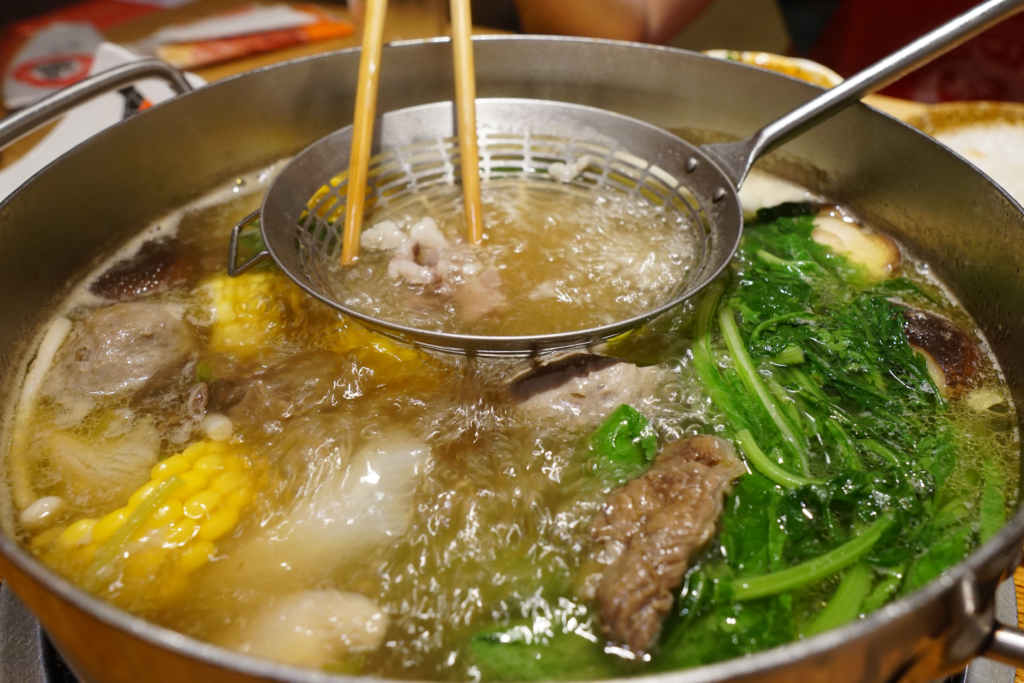
    To fully enjoy the dish, place the meat in the sieve spoon provided and wait for 10-20 seconds, depending on the cut. The beef slices are incredibly tender and will practically melt in your mouth.

    You will also notice the beef balls floating in the fragrant broth. Take your time before consuming them to ensure they are well cooked. The balls absorb the aromatic broth and, with their firm and elastic texture, provide a welcome contrast to the meltingly tender slices of beef.

    In addition to various beef dishes, we also had cow stomach, tofu, crispy mushrooms, vegetables from the Chaoshan province, and nourishing rice noodles that evening.

    At first glance, the tofu resembles oversized potato chips. However, looks can be deceiving. After cooking, it transforms into an elastic delicacy soaked in a fragrant sauce, reminiscent of a giant ribbon noodle.

    At the sauce bar, you can create your own dipping sauce. The base consists of house-made sesame and peanut sauces, fresh herbs, and various spice blends. This allows you to customize your sauce to your liking.

    In addition to the listed ingredients, fresh celery is also included. Place some of it in a small bowl and add broth from the hot pot after a certain cooking time. Taste the selfmade soup from the bowl. It is truly irresistible, especially when the aroma of the ingredients has mixed with the broth.

    The highlight of this dish is the tender beef pieces that float in the broth. They are served directly in the pot and can be enjoyed after consuming the other ingredients. The beef is so tender that it melts in your mouth, releasing its full, savory flavour.

    To sum it all up, if you were ever to come to Shanghai, you should definitely visit JinRi Niu Shi Restaurant and try the famous Chaoshan Beef Hotpot!

  • Enchanting Shanghai: Rediscovering the City and it’s Culinary Secrets After 5 Years Abroad

    Enchanting Shanghai: Rediscovering the City and it’s Culinary Secrets After 5 Years Abroad

    Shanghai – the city where I had the pleasure to spend wonderful years – still fascinates me after many years. A leisurely stroll along the picturesque tree-lined avenues in the French Concession, the hustle and bustle in the subways, and the impressive atmosphere in Pudong are still vivid in my memory. Now, after 5 years and due to the lifting of the COVID-19 restrictions, we finally had the opportunity to travel back to China, and our first stop was, unsurprisingly, Shanghai.

    In this article, I would like to introduce you to Shanghai’s most famous attraction, the “Wallpaper Classic” – the promenade known as “The Bund” – and take you on a journey through the highly popular pedestrian zone, Nanjing East Road, which is loved by both tourists and locals (in another post, we had already explored Jianghan Road in Wuhan). Additionally, we will delve into the excellent cuisine from Yunnan, which is a new addition to this blog.

    Why visit Shanghai? While it may not boast the density of cultural monuments of cities like Beijing, Shanghai’s impressive blend of tradition and modernity makes it one of the world’s most important metropolises. The imposing skyline and historic districts with traditional architecture, along with the international flair, culinary diversity and monumental landmarks, make Shanghai a unique destination.

    How to get there?

    • Shanghai Intl. Airport – one of the country’s largest airports with connections worldwide.
      • The city center is easily accessible by Maglev train/subway or taxi/DiDi (the Chinese Uber).
    • (High-speed) Train – connects to most major urban areas in the country, ideal for those planning to explore other Chinese cities.
      • E.g. for the Shanghai – Beijing route, depending on the connection, it takes approximately 4-6 hours.
    • Car – be cautious of the dense traffic in Shanghai; opt for train or flight.
      • Note: International driver’s licenses are not valid in China.

    Where to stay?

    • Xuhui: Home to the charming French Concession with tree-lined streets, boutiques, cafes, and art galleries, and the creative Tianzifang artist quarter.
    • Huangpu: Centrally located with quick access to restaurants and attractions such as The Bund, Nanjing Road, Yuyuan Gardens, and Old Town Shanghai (Nanshi).
    • Jing’an: A lively district – featuring the Jing’an Temple and Zhongshan Park. A mix of trendy shopping centers, restaurants, and bars.
    • Pudong: In the heart of Shanghai’s famous skyline, a modern district with the city’s crucial financial district and many business and luxury hotels.

    Shanghai currently has the largest subway network in the world with over 20 lines. The subway runs at frequent intervals and provides easy access to all parts of the city. The Shanghai subway is well organized, efficient, and comfortable, with modern, clean, and well-maintained trains and well-signposted stations.

    Shanghai’s culinary diversity is remarkable. There are restaurants from every province in the country, as well as from other countries and cultures around the world. From local Shanghai cuisine to Sichuan classics, burger joints or upscale international dining, you can find it all here. You’ll even come across traditional German cuisine. There’s really something for everyone! On the downside for enthusiasts of authentic Chinese cuisine, the street food scene is gradually shrinking. Along the city’s path to modernization, many small stalls and markets have been closed, which is a pity in my opinion.

    As mentioned above, in this blog post I would like to introduce you to the dishes of Yunnan, a province that is often overlooked but has an excellent cuisine. Yunnan is one of the most picturesque provinces in the country and one of the ethnically diverse regions of China with a large number of different minority groups. This is also reflected in the country’s cuisine with diverse flavors and spices, and many natural ingredients.

    During our visit to Shanghai, we dined at a restaurant (Yun Hai Yao 云海肴) that I hadn’t been to in years. The anticipation builds as we enter the restaurant. We’ve spent wonderful hours here enjoying hot tea and spicy Yunnan dishes with our friends while chatting about everyday things.

    And what have we got this time? We start with a classic, rice noodles, the staple food of Yunnan, in an aromatic broth with mushrooms from the province’s rich forests and mountains (金汤肥牛菌菇米线). A simple version of “Crossing the Bridge Noodles” (Guoqiao Mixian – 过桥米线), often served as a soup base with a selection of raw ingredients cooked in hot broth. The name of the dish comes from an old legend about a woman who had to cross a bridge every day to bring food to her husband. To keep the food warm, she prepared the broth beforehand and combined it with various ingredients while crossing the bridge.

    The noodle soup is spicy and slightly sour, offering a balanced flavor palette with the meat broth and fresh ingredients like vegetables, meat and mushrooms.

    Next comes one of my all-time favorite dishes: wild porcini mushrooms with fried bacon (野生牛肝菌炒腊肉). You can almost taste the spirit of Yunnan’s forests and mountains. The porcini mushrooms are crisp and fresh, with a subtle roasted taste. The smoky, spicy flavor of the bacon, combined with Yunnan’s spices, provides a delicious contrast of textures and flavors.

    Next up is Huopiao beef stew (火飘牛肉煲), a type of spicy beef stew. This dish combines tender pieces of beef stomach, mandatory Yunnan mushrooms, various vegetables (such as green onions), and is cooked in a spicy broth. Ideal for food lovers who appreciate both offal and spicy chilies.

    The last dish of the day is our highlight and visually stunning: Grilled Lemongrass Tilapia (泰味香茅草靠烤罗非鱼). The tilapia is prepared on a charcoal grill. The flavor is characterized by fresh lemongrass, spicy seasonings, fresh Chinese herbs such as coriander, and the mild, smoky aroma of grilled tilapia. It is served with whole chiles and lightly sauteed tomatoes. It is truly a feast for the eyes! And it tastes as good as it looks. The fresh lemongrass blends with the heat of the chiles and the smoky, juicy tilapia – refreshing and savory at the same time. Here you can see the cultural diversity of Yunnan, with influences from both Chinese and Southeast Asian cuisines.

    After a hearty meal, we head out to explore the city. We take the subway and get off at Nanjing East Road Station – Line 2. Coming out of the subway, one is immediately overwhelmed by the famous shopping street of the city – Nanjing East Road. Dense crowds, towering buildings and lights everywhere. Well-preserved historical buildings and modern architectural monuments reflect the city’s development from colonial times to China’s financial capital. There are food markets, food stalls, chic restaurants, large inviting shops and luxury boutiques. Especially after dark, the street transforms into a lively and colorful atmosphere with impressive lighting. It’s a good idea to take a stroll down the pedestrian mall in both directions; you’ll be surprised at every turn.

    However, the absolute highlight, especially in the evening or at night, is the waterfront promenade “The Bund“. On the western side in Huangpu, there are impressive architectural remnants of the colonial era, such as the Peace Hotel and the Customs House. On the eastern side in Pudong, the world-famous skyline rises with colossal buildings such as the Shanghai Tower, the Jin Mao Tower and the wonderfully colorful TV Tower.

    Despite the large crowds, especially in the evening, a visit is highly recommended. The play of colors in the skyline, the imposing historical buildings, the wide Huangpu River with its countless brightly lit boats and the extensive waterfront promenade make this attraction truly special. It is a vivid demonstration of the colossal size of this Asian metropolis.

    Hope you enjoyed this guide? Next time in Shanghai, we will introduce you to our favorite hotpot from Chaoshan and give you some insights into the shopping paradise of Shanghai. See you soon!