Tag: Spicy

A collection of posts featuring Spicy food.

  • Unleash the Fiery Flavors of Sanku-Maotsai: Authentic Sichuan Maocai in Frankfurt

    Unleash the Fiery Flavors of Sanku-Maotsai: Authentic Sichuan Maocai in Frankfurt

    Contrary to what the name might suggest, the restaurant Sanku-Maotsai, located just a few minutes’ walk from Frankfurt main station, is not about Maotai or Moutai – a type of baijiu, a traditional Chinese liquor or schnapps. Instead, the name refers to a popular authentic Chinese dish called Maocai (冒菜) from Sichuan Province, known for its spicy and aromatic cuisine.

    Restaurant Profile

    All spices are imported directly from Sichuan to ensure an authentic taste experience. Look out for recurring discount promotions and free side dishes (like chicken feet to try – maybe not everyone’s cup of tea, but a unique experience😊).

    Vegetarians are also well catered for at Sanku-Maotsai, with a wide variety of vegetables, mushrooms, tofu, noodles and more.

    But what exactly is maocai? This dish is a combination of various ingredients such as meat, fish, seafood, tofu and vegetables cooked in a spicy broth or stir-fried, similar to the famous hotpot or malatang.

    Three words, three dishes, and it’s easy to get confused: hotpot, malatang, and maocai. Here’s a quick guide to clear up the confusion:

    • Hotpot (some excellent hotpot restaurants in Frankfurt, for example, are Liuyishou and Sen (vietnamese Version)) is an interactive experience where fresh, pre-selected ingredients are cooked together in a large pot – one of the absolute classics of Chinese cuisine.
    • Malatang (if you want to learn more about Malatang, you can find a restaurant in Frankfurt here) and Maocai differ from Hotpot mainly in that the ingredients are not cooked together in a broth at the table, but are already prepared in the kitchen and then served.
    • With maocai, the differences go a bit further, for example, different spices and sometimes Chinese medicinal herbs are used for the broth, and there is also a “dry” version.

    For this restaurant, we want to focus on dry maocai (香辣干拌), which is made by briefly blanching the ingredients and then stir-frying them in a pan with hot sizzling oil, dried chilies, Sichuan peppercorns, garlic and ginger. Soy sauce, rice wine and a little sugar are added.

    Everything is mixed well and simmered briefly until the flavors are fully developed and the ingredients are cooked to perfection.

    Dry maocai is served hot and is characterized by its pronounced heat and the distinctive, slightly numbing “mala” sensation on the tongue caused by the chilies and Sichuan pepper. It also has a deep, savory umami flavor from the meat, soy sauce, and other flavor-enhancing ingredients.

    While ingredients cooked in a broth become tender, juicy, and aromatic, dry maocai retains the original texture of the components: vegetables remain crisp, and meat or seafood develops a firmer, often slightly caramelized surface. Dry Maocai has a more intense and concentrated flavor because the spices and seasonings adhere directly to the ingredients and are not diluted by a broth. It is this combination of bold flavors and varied textures that probably makes the dry version even better for me than the broth-based one …

    It is similar in taste to ma la xiang guo (such as what you find at the China Haus in Frankfurt) or gan guo, where the ingredients are also served in a spicy sauce with minimal liquid.

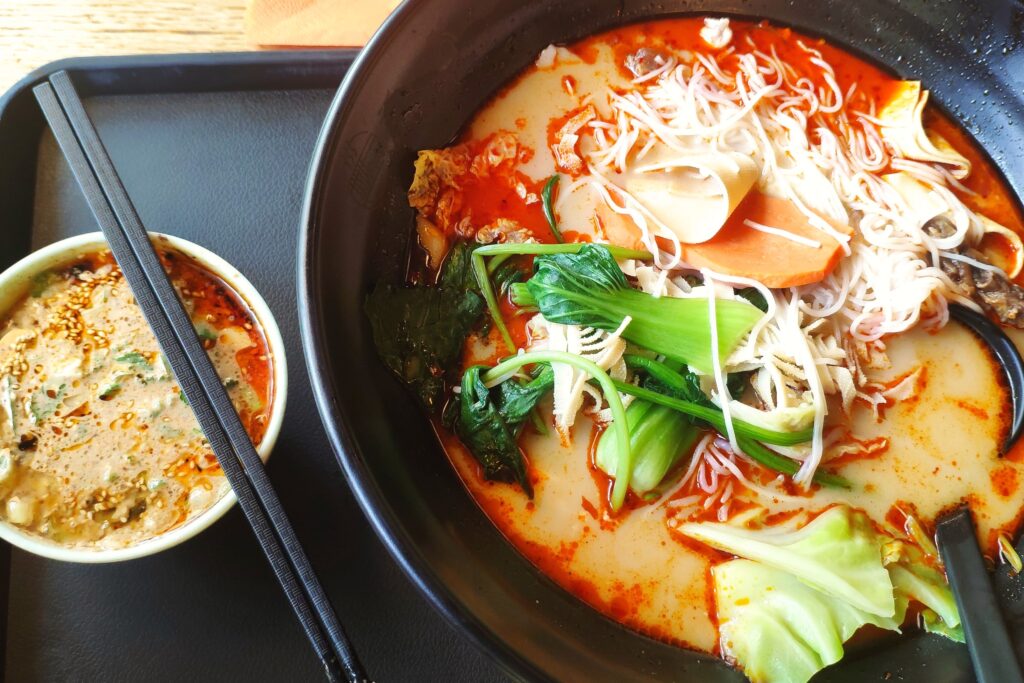
    If you still prefer the soups, here is an overview – the following broths are available:

    • Spicy soup – traditional Sichuan spicy (经典川味 – jīng diǎn chuān wèi)
    • Tomato soup, mild (浓香番茄 – nóng xiāng fān qié)
    • Sour soup with sauerkraut – spicy, but slightly milder than the spicy soup (老坛酸菜 – Lǎo tán suān cài)
    • Fresh soup with cooked mushrooms, mild (鲜香三鲜 – xiān xiāng sān xiān)

    If you are a regular reader of our blog, you are probably already familiar with the following process. Start by grabbing a bowl and tongs at the entrance, then head over to the food station and explore the wide array of ingredients. You’ll find everything a maocai lover could want. This includes various meats (some marinated, meat rolls, meatballs, etc.), seafood and fish, a variety of vegetables (broccoli, carrots, cabbage, pak choi, etc.), mushrooms, tofu, and several types of savory noodles. Fill your bowl with your favorites, then choose your preferred cooking method – we recommend the dry maocai. Alternatively, you can choose from the broths listed above. For a small surcharge of 2 euros per person, you can also order an unlimited rice option.

    After placing your order, you will receive a pager. While your maocai is being prepared, you can create your own dipping sauce at the sauce buffet – we’ve covered this in other posts (e.g. Liuyishou in Frankfurt or Haidilao in Wuhan). The base sauces are golden-brown peanut and sesame sauces. We recommend adding garlic, coriander, shallots, and a bit of chili (though you may want to skip the chili since the maocai is already hot). Feel free to experiment and adjust to your taste.

    Now that you have hopefully gotten a good impression of the delicious dishes, have fun trying them out and enjoy your meal at Sanku-Maotsai!

  • Thai Boat Noodles: A Taste of Authenticity, Tradition, and Nostalgia at Soi 22

    Thai Boat Noodles: A Taste of Authenticity, Tradition, and Nostalgia at Soi 22

    Step into the vibrant world of Thailand right here in Frankfurt at our latest culinary hotspot – Soi 22. This new Thai restaurant is a must-visit for anyone craving the true taste of Thailand. From the moment you walk in, you’ll be enveloped in the lively ambiance and charming decor that reflects an old tradition uniquely Thai – the boat noodles culture.

    The owner, passionate about bringing authentic Thai experience to Germany, has recreated the unique and historic tradition of “boat noodles” (Kuay Teow Reua). Originating from the Ayutthaya period (1351-1767), these noodles were once sold from boats along Thailand’s bustling canals, when canals were the primary means of transportation in many parts of Thailand. Vendors would paddle their boats along canals, preparing and selling bowls of noodles to people on the banks or other passing boats.

    With the decline of canal transport, boat noodle markets have made their way to land-based stalls and restaurants, evolving into vibrant cultural and recreational hubs. Soi 22 beautifully mimics this traditional flair with decor like barber shops and massage parlors, creating an atmosphere that transports you straight to a charming miniature version of a Thai boat noodle market.

    Restaurant Profile

    Before diving into the food, let’s introduce you to two indulgent yet refreshing Thai iced tea creations.

    Thai Ice Tea with Lemon, made from a blend of black tea and spices such as anise and tamarind, has a deep, ruby-red hue. The addition of a slice of lemon enhances its bright, lemony sweetness with a subtle tang.

    Thai Ice Tea with Milk offers the creamy, indulgent side of the Thai iced tea. The tea blend with spices gives it a deep amber color that remains visible at the bottom where it hasn’t been mixed fully with milk. It creates an appealing contrast of creamy white on top and rich golden tea below. A sprinkle of cinnamon on top adds a touch of warmth that complements its luscious, milky flavor.

    Though not meant for cooling the thirst, these sweet, refreshing treats are perfect for balancing the bold, spiced Thai flavors, making them a hit for those who love rich, dessert-like drinks.

    Soi 22’s carefully selected starters bring the authentic flavors of the Thai night market right to your table, featuring popular local snacks like crispy wontons and crispy pork fat. You won’t want to miss the A1 Grilled Pork Balls and A4 Steamed Spicy Prawn Wontons— the absolute must-try dishes at Soi 22.

    A1 Grilled Pork Balls features nine freshly handmade pork balls, served on three skewers and topped with cilantro and a slice of red bell pepper.

    Expertly crafted, the meat balls taste incredibly fresh and bouncy, offering a satisfyingly firm texture. The slightly charred surface adds a delightful chewiness and smoky flavor. Generously dip them in the sauce for a blend of smoky, tangy, sweet and subtly spicy notes. It wonderfully enriches the savory, umami-packed meat balls, adding tantalizing layers of taste to every bite!

    A4 Steamed Spicy Prawn Wontons is a dish that had the diner next to us exclaiming “seafood paradise!” And we wouldn’t disagree.

    This exquisite dish features three meticulously crafted wontons, each generously filled with two succulent black tiger prawns. Bathed in a dark, aromatic fish sauce and topped with cilantro and fresh chili, these wontons are a true taste sensation.

    Each wonton bursts with natural sweetness of juicy prawns, perfectly complemented by the bold spices. The delicate steamed wrapper is soft and slightly chewy, melting in your mouth and beautifully contrasting with the firm, plump prawns inside.

    The accompanying spicy, tangy, and slightly sweet fish sauce enhances the overall flavor. Be warned, the sauce packs quite a spicy punch, but it’s this heat that makes the dish so invigorating. Take a bite, and you’ll be hit with an exhilarating blend of textures and flavors—the tender prawn filling, the soft wonton wrapper, and the spicy, umami sauce.

    For those who find the spice level too intense, the sweet Thai drinks can be your remedy here. But trust us, every spicy, flavorful bite of these wontons is worth the heat. It’s truly a piece of seafood paradise.

    Now, let’s dive into the main event—Thai boat noodles! These come with a dark, luscious broth, known for its rich and intense flavors, thanks to a blend of spices, herbs, and sometimes even pig or cow blood for added depth and thickness. At Soi 22, they stick to tradition with a moderate portion of broth, just like in the old days when rickety boats were prone to spillage. But don’t worry— if you want more, you can get extra broth at no extra charge.

    For your noodle bowl, you can choose from a variety of ingredients, including tender beef, flavorful beef balls, and a selection of offal. Each dish is accompanied with Thai basil and crisp bean sprouts for a burst of freshness and crunch.

    You can enjoy your noodles with or without broth, and pick from egg noodles, thin or thick rice noodles.

    For an extra kick, you can add chili flakes, pickled sour chili, fish sauce, and sugar. The Thai chili flakes pack a serious punch, so sprinkle with caution!

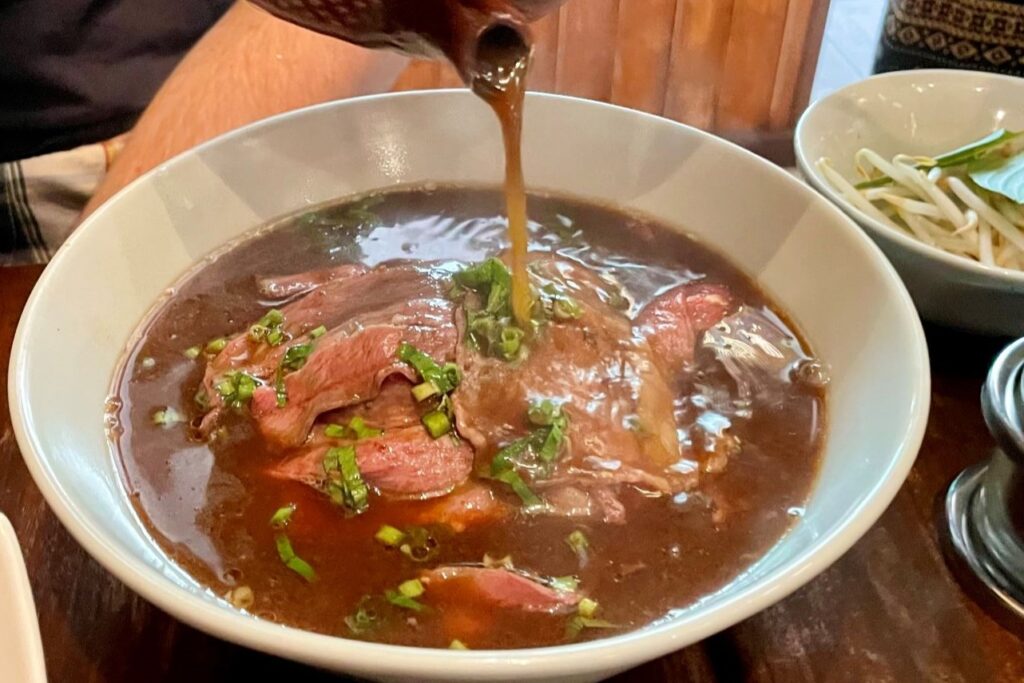
    N6. Nam Tok Wagyu A5 Sliced Wagyu takes Thai boat noodles to a whole new level. This dish features premium A5 Wagyu beef, sliced thinly and served raw, flaunting its rich marbling and vibrant red color. It’s a feast for the eyes and the palate, promising a succulent, beefy sensation.

    Generously layered over the noodles, the raw Wagyu is cooked right at your table. Watch in awe as the staff pours hot broth over the beef, transforming it into juicy tenderness right before your eyes. This theatrical cooking process ensures the Wagyu’s buttery richness is preserved at its freshest, elevating the dish to luxurious heights.

    The dark, robust broth, infused with a complex blend of spices, herbs, and a hint of tanginess, superbly complements the rich, savory Wagyu. Fresh Thai basil and crisp bean sprouts add a refreshing crunch and balance to the rich flavors.

    Be sure to stir the noodles right after adding the broth, as the thick, flavorful concoction can make the noodles mushy if left still for too long. Each mouthful delivers a tantalizing mix of tender beef, rich broth, and vibrant toppings — a lavish twist on traditional Thai boat noodles that is sure to impress.

    N5. Nam Tok All-In is the epitome of authentic Thai boat noodles, uniting a delectable assortment of beef components in one bowl. This dish features sliced beef, braised beef, beef balls, tendon, liver, and tripe, delivering a genuine taste of traditional Thai flavors.

    The rich, thick broth deepens the savory flavors of the tender sliced and braised beef, with the braised beef adding an extra layer of melt-in-your-mouth goodness. The beef balls are chewy, firm, and bursting with flavor. The tendon, soft and gelatinous, fully absorbs the richness of the broth. The liver offers a bold, earthy flavor that adds complexity, while the tripe is chewy and slightly spongy, providing a unique texture.

    Enjoy this dish with the robust broth and fresh veggie toppings like Thai basil and bean sprouts. Each spoonful is intensely flavorful, with a refreshing crunch and brightness that balances the rich savoriness.

    The variety of beef cuts are staples in classic Thai boat noodles, making it a top choice for those craving an authentic taste of Thailand.

    The only dessert offer at Soi 22 is the E1. Original Khanom Thuay, and it’s nothing short of extraordinary. This steamed coconut pudding has a smooth texture and a rich, layered flavor.

    Khanom Thuay consists of two layers: a silky, slightly salty coconut custard on top and a subtly sweet, steamed rice flour base below. The bottom layer is tender and smooth, while the top layer is luxuriously creamy, bursting with aromatic coconut flavor.

    Each bite blends sweet, savory, and creamy notes with a light, melt-in-your-mouth quality. For the best experience, use the bamboo spoon to gently scrape from the edges, ensuring you get both layers in every bite. This indulgent dessert will impeccably round off your meal at Soi 22.

    At the end of our meal, we were treated to a sweet surprise not listed on the menu: Palm Sugar, Milk, and Coconut Dessert, a complimentary goodie on the house. This dessert features a soft, cake-like base that’s lightly spongy and sweetened with palm sugar, giving it a warm, golden color and a rich, earthy sweetness.

    Crowned with shredded coconut, it lends an enjoyable chewiness and a hint of nutty flavor, highlighting the dessert’s subtle tropical notes. The coconut’s slightly fibrous texture contrasts nicely with the soft, airy base, combining the indulgent sweetness with a pleasantly light touch.

    The atmosphere at Soi 22 is infectious, as every guest seems to revel in delicious food and joyful mood. The staff greets every guest with traditional, heartfelt gestures—hands pressed together and a gentle “sawadika” (hello in Thai), a subtle bow that speaks volumes of their grace and humility. In quieter moments, the owner himself would take the time to chat, sharing stories about each dish, from its origins in Thailand to the influences from neighboring countries. His passion for the cuisine and the restaurant was palpable.

    Soi 22 is undoubtedly a taste of authentic Thai fare. More than that, it’s an immersion into a slice of Thailand’s soul, where simplicity and authenticity shine brightest, steeped in tradition, warmth and a sprinkle of nostalgia.

  • Mamma Bao: Where Traditional Biang Biang Noodles and Bao Meet Modern Flair

    Mamma Bao: Where Traditional Biang Biang Noodles and Bao Meet Modern Flair

    Ready for a culinary adventure at one of Munich’s hottest restaurants? At Mamma Bao, you can indulge in authentic Chinese cuisine, from delicious Biang Biang Noodles to the restaurant’s signature Bao, after which the restaurant is named, and many other culinary highlights right here in Munich!

    Curious about Biang Biang Noodles and Bao? Don’t worry, I’ll get to that in a minute. But first, let me give you a little background on this vibrant restaurant.

    Mamma Bao takes classic Chinese dishes and adds a modern twist, celebrating bold flavors and unique presentations. Thanks to its growing popularity, there are now two locations in downtown Munich, with a new branch recently opened at Adalbertstrasse 8. Reservations are not accepted, so be prepared to wait, especially during peak times. While you wait, feel free to browse our blog for more inspiration and tips 😉

    Restaurant Profile

    On our visit, we opted for a delicious combination of two types of bao and two portions of biang biang noodles. As always, we shared everything so that we could both enjoy a little bit of each dish.

    Let’s dive into the world of baos, which are based on mantou (馒头), traditional steamed buns. These buns are a staple of Chinese cuisine, especially in northern China, where wheat is as common as rice. Made from a simple yeast dough and steamed to perfection, baos are delightfully fluffy and light. Their versatility shines through as they pair beautifully with main dishes, soaking up sauces, or can be enjoyed on their own, perhaps with a cup of warm soy milk for breakfast or as a snack, sometimes with a savory or sweet filling.

    Mantou holds a special place in my heart. Its mild, slightly sweet flavor, airy texture, and comforting warmth, especially after a spicy Chinese meal, bring back fond memories. It’s almost like a sponge, soaking up excess oils and fats and soothing the stomach.

    At Mamma Bao, you’ll find stuffed mantou, also known as bao (包) or buns. These creations are similar to burgers, so you might think of them as “Chinese burgers“. The term “包” (Bāo) means “package” or “wrapped” and refers to a variety of stuffed buns and dumplings. These include steamed dumplings and baozi, which we’ve discussed in previous posts – one of my all-time favorite Chinese dishes – as well as mantou.

    Let’s not keep you in suspense any longer. We tried a Mr. Pork Bao (Hóngshāo Ròu Guābāo – 红烧肉刮包) and a Mushroom Bao (Xiānggū Guābāo – 香菇刮包) and they were as delicious as they sound.

    Mr. Pork Bao features a rich filling of braised pork belly, red onion, cilantro, and crushed peanuts. The pork belly is slowly braised in a fragrant mixture of soy sauce, sugar, Shaoxing wine, ginger, garlic, and an array of spices. This process results in exceptionally tender meat with a glossy, caramelized surface. The flavor profile is a perfect balance of sweet and salty notes, while the red onions add a mild, slightly sweet crunch. Fresh cilantro lends a citrusy brightness to the robust, spicy sauce, and the crushed peanuts contribute a delightful crunch and nutty flavor, creating a harmonious blend of textures and tastes.

    Mushroom Bao (香菇刮包, xiānggū Guābāo) features oyster and shiitake mushrooms (香菇 stands for shiitake mushrooms) in a thick, glossy soy sauce. This bao offers a delightful fusion of flavors and textures. The savory, slightly sweet soy sauce blends with the rich, earthy flavor of the mushrooms and the soft, mild mantou bun. The mushrooms are tender and juicy, the soy sauce is thick and flavorful, and the bao is light and fluffy. It’s a wonderful combination!

    After admiring and perhaps tasting the filling, gently fold the mantou together-taking care not to break the delicate bun. Pick it up and take a bite; it’s just like a Chinese-style burger! Chopsticks or a knife and fork may come in handy if the bun falls apart or you have difficulty eating. The delightful contrast between the soft, subtly sweet mantou and the savory sauces, meats, and vegetables makes for a truly delicious experience!

    Let’s dive into Biang Biang noodles, a famous specialty from China’s Shaanxi province and a hallmark of Xi’an, the ancient capital.

    I vividly remember my visit years ago to Xi’an, the city famous for the Emperor’s Tombs and the legendary Terracotta Army. It was during this trip that I discovered my passion for Biang Biang noodles – an irresistible and remarkably affordable local delicacy.

    These hand-pulled noodles are known for their remarkable width and thickness, which can reach up to 3-4 cm. The dough is skillfully pulled and stretched by hand several times until it reaches the desired consistency. The name “Biang Biang” is inspired by the onomatopoeic sound of the noodles being pulled and folded.

    Fun fact: The noodles even have their own unique Chinese character. “Biang” is one of the most complicated characters in the Chinese language and cannot be easily typed on a standard keyboard. As a result, phonetic spellings such as 棒棒麵 (Bàngbàng Miàn) or 梆梆麵 (Bāngbāng Miàn) are often used to represent it.

    At Mamma Bao, the Biang Biang noodles come in a generous bowl, seasoned with soy sauce and, depending on your spice preference, a house-made chili sauce. You can choose from mild (Non-Spicy), medium (Standard-Spicy), or the truly authentic level of heat (Asian-Spicy). Of course, we chose the authentic version.

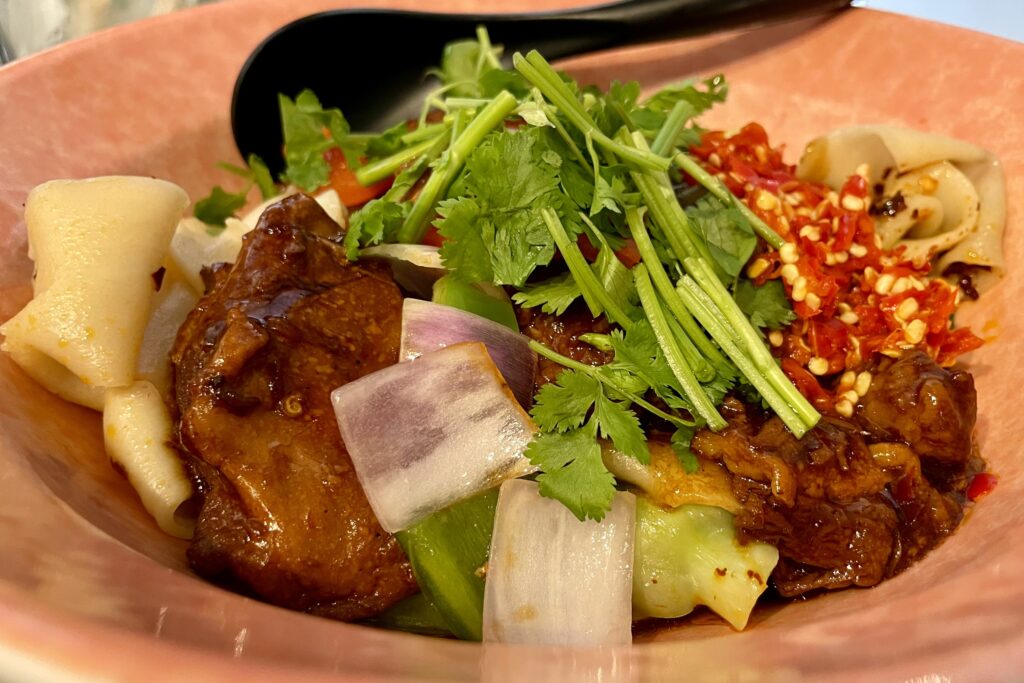
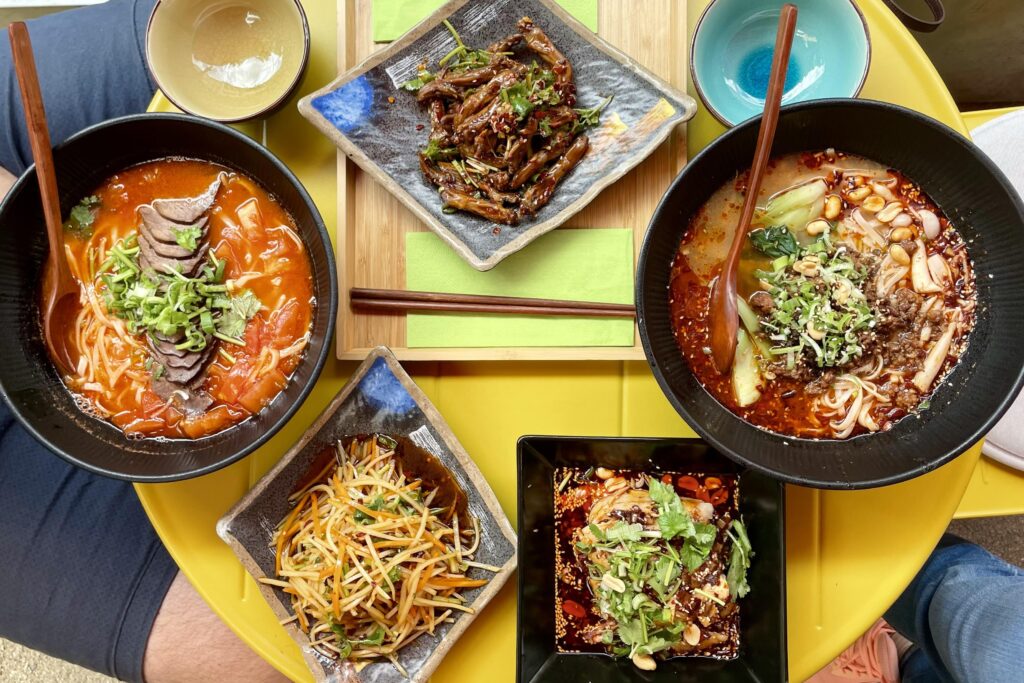
    We ordered both the classic Biang Biang noodles (油泼面) and the Biang Biang beef noodles (西红柿牛肉三合一面).

    Simply Biang Biang Noodles (Yóu Pō Miàn – 油泼面) is a delicious vegetarian dish featuring a vibrant mix of cabbage, garlic, chives and a signature house sauce.

    The essence of this dish lies in the sauce, which is made from pickled chili peppers that add a subtle heat and light tang. The Biang Biang noodles themselves have a chewy yet tender texture. Their wide, thick strands are perfect for soaking up the rich, spicy sauce and provide a satisfying mouthfeel. Generous sprinkles of aromatic garlic add a distinctive flavor that truly elevates the dish.

    The slightly sweet herbs and chives offer a crisp, refreshing contrast to the bold, spicy and oily garlic sauce, creating a harmonious balance of flavors and textures.

    The Simply Biang Biang Noodles are known for their bold spices and robust flavor, but also for their rather simple and minimalist preparation. In contrast, the Biang Biang Beef Noodles (西红柿牛肉三合一面 – Xīhóngshì Niúròu Sān Hé Yī Miàn, which translates to “Tomato Beef Noodles Three-in-One“) are incredibly rich and creamy. The term “three-in-one” emphasizes the harmonious blend of three key ingredients in a single dish.

    The noodles are accompanied by a rich, savory sauce made with tender, slow-cooked beef, tomatoes, eggs and cilantro. The beef is juicy and flavorful thanks to its long, slow cooking. The tomatoes contribute a fruity, slightly sweet and tangy note that brightens the dish and balances the hearty meat. The egg adds a creamy texture and mild flavor, further enhancing the dish and adding extra protein. Finally, crisp bok choy and fresh cilantro add a burst of freshness and a hint of citrus to complete the flavor profile.

    Quick Note: As with many Chinese noodle dishes, it is important to stir thoroughly before eating. This will ensure that all the ingredients blend together perfectly, allowing the complex flavors to fully develop. If the sauce separates over time, a quick stir will restore the ideal consistency.

  • Off-the-Beaten-Path Bliss on Gran Canaria: Secluded Beaches and a Hidden Family-Run Tavern

    Off-the-Beaten-Path Bliss on Gran Canaria: Secluded Beaches and a Hidden Family-Run Tavern

    For those seeking a serene escape from Gran Canaria’s bustling tourist hubs, Playa de Tiritaña and Playa de los Frailes are the perfect spots. These relatively secluded beaches are easily accessible by car, with Playa de Tiritaña just a short 10-minute drive from Playa de los Frailes.

    We parked our car about 10 minutes’ walk from Playa de Tiritaña. The way there felt like a passage through a forgotten dreamscape, marked by an unfinished road nearby that looked like a part of an abandoned resort project. The sky was a mesmerizing shade of blue, casting its brilliance over the landscape. Stone formations atop a nearby hill stood like ancient sentinels, silently watching over this hidden retreat that sees fewer visitors. All this adds a unique, mystical charm to the area.

    Upon arrival at these rocky bays, we were greeted by a rugged and intimate sanctuary. Unlike the typical sandy beaches, here you’ll find larger stones and pebbles. The natural solitude easily envelops you. In this peaceful corner of the world, the only sounds are the slow, rhythmic waves caressing the shore.

    In the naturally formed ponds on the beach, you’ll easily spot playful little fish frolicking freely in the sunlight. Even the usually shy crabs make a bold appearance, basking in the sun for a moment before quickly scurrying back into the shadows under the rocks.

    The water is cool and inviting, nestled against the mountains that hug the coastline, creating a perfect natural setting for a refreshing swim. However, it’s wise to be cautious of the rocky terrain and occasional strong currents.

    If you’re feeling adventurous, you can take a one-hour hike over the mountains that connect Playa de Tiritaña to Playa de los Frailes, and enjoy the stunning coastal views along the way. Despite its uneven paths and occasional steep sections, the trail remains manageable for most hikers.

    As we ascend the hill, leaving behind all sounds except the ocean’s distant ebb and flow, we feel ourselves shedding, layer by layer, our weariness and ambitions, wandering into a vast emptiness where the horizon draws near and stretches far, all at once. It’s as if we’re caught in a transient interlude of time and space; the world slows down and everything feels suspended in this quiet majesty.

    At Playa de los Frailes, you’ll have softer sands that attract beachgoers seeking a quieter seaside experience. A cliffside trail to the right will lead you to a more tranquil spot.

    Perched upon the stone piles at the trail’s end, we found a corner that felt both vast and intimate, with boundless sea and sky stretching infinitely before us.

    As we watch the seawater change its colors in the sunlight and shadows, see it wash over strands of light, see it reflect every grain of sand and stone, see it sometimes raging, sometimes calm, time passes unnoticed. A distant boat drifts by; its sailor appears to notice us and waves warmly from afar. We return the heartfelt gesture—a fleeting yet heart-stirring encounter, treasured all the more in our solitude.

    Tips for your visit:
    • Rocky Shores: The beaches are rocky, so it’s a good idea to bring water shoes to protect your feet when getting into the water.
    • Hiking Essentials: Wear sturdy hiking shoes and carry plenty of water when trekking between the two playas. The trails can be uneven and demanding.
    • Stay Sun-Safe: Pack sunscreen, a hat, and sunglasses. The sun can be intense, and there’s minimal shade along the trails. Start your hike early to avoid the peak heat.
    • Cliffside Cautions: If you’re walking along the cliff trail, be mindful of loose rocks and narrow paths.

    After a day of walking and climbing, what could be more rewarding than a delicious Spanish feast? This time let us introduce you to an absolute must-try restaurant on this island – La Tasquita Gallega. This family-run Spanish tavern serves up almost all the coastal flavors you could possibly crave while visiting Gran Canaria – grilled meats, veggies, fish, seafood, paella of different kinds, and an extensive selection of tapas. Check out their menu here.  

    With such a tempting array of tapas dishes, you can dive into a variety of flavors by ordering smaller portions at adjusted prices—just as we did!

    Our first tapas choice quickly became one of our favorites: Empanadillas, or Spanish dumplings.

    These savory pastries are stuffed with seasoned minced meat, boasting an irresistible, aromatic taste. The flavorful seasoning includes sautéed onions and garlic forming a fragrant base, complemented by oregano, fresh paprika, and earthy cumin. Salt and pepper perfectly round out the flavors, enhancing the juicy, rich minced meat, all encased in a crisp, golden pastry shell that delivers a satisfying crunch with every bite!

    The oysters at La Tasquita Gallega are remarkably plump and juicy.

    Each one comes in an exceptional size and bursts with a clean, briny flavor that evokes the freshness of the sea. The texture is smooth and slightly firm, providing a satisfying chew. Enjoy them raw, with a squeeze of lemon to enhance their natural sweetness and slightly salty flavor. Each morsel delivers a luxurious, refreshing taste that lingers on the palate.

    Padrón Peppers, featured in our previous post, are a go-to tapas for us.

    Quickly fried in olive oil until blistered and tender, they’re beloved for their simple and fresh taste. Served with a sprinkling of sea salt, they offer a savory contrast to their naturally mild, slightly sweet flavor. This vegetarian dish is ideal as an accompaniment to any other tapas or main meal, adding juiciness and crunch.

    Galician Chorizo is known for its rich, savory flavor profile. It has a very robust taste with hints of pepper, garlic, and other aromatic spices used in its seasoning.

    The sausage combines juicy, flavorful pieces of fat with lean meat, creating a firm texture and satisfying chewiness. When stir-fried with onions and bathed in a slightly spicy sauce, it develops a deep, hearty taste that is both savory and subtly tangy. With slightly sweet onions to balance out the rich meaty flavor, it’s a very delicious and well-rounded dish.

    Vieras al Horno, or Spanish Baked Scallops, is a delectable tapas dish, cherished for their exquisite flavors.

    Fresh, plump scallops are delicately baked to a perfect tenderness, accompanied by chopped onion cubes and parsley. These scallops, prized for their buttery, briny and even mildly nutty flavors, take on a subtle umami richness when cooked with aromatic onions and peppery parsley. They add vibrant color to the dish and elevate the natural sweetness and gentle brininess of the scallops, making each morsel thoroughly enjoyable to eat.

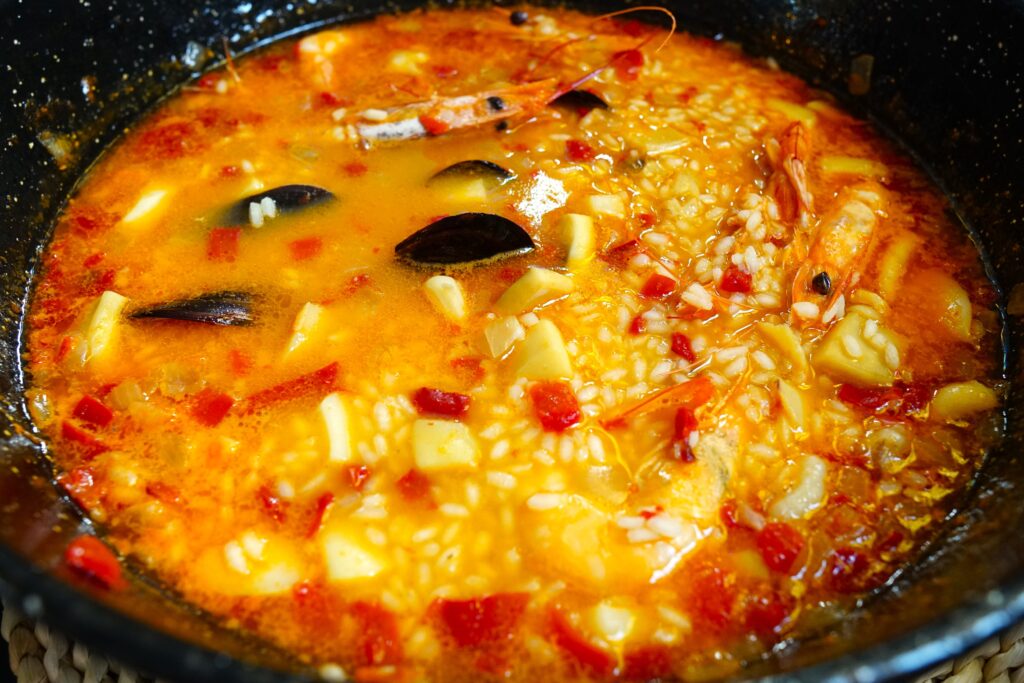
    Arroz Caldoso de Marisco holds a special place in the Canary Islands cuisine, offering a sensory enjoyment for its rich flavors and comforting nature.

    It’s served in a soup bowl brimming with tender rice infused with saffron, imparting a warm golden hue and a subtle floral aroma. This dish is a grand celebration of seafood – succulent squid, briny mussels, plump shrimp, and tender octopus — all simmered in an aromatic broth that reveals luscious oceanic flavors and freshness.

    Despite being cooked in a soup, the rice remains distinct and firm, setting it apart from porridge. It absorbs the broth’s rich flavors while maintaining its integrity. Scoop up some rice with other ingredients – the sweetness of seafood balanced by the hey-like, grassy notes of the saffron, accompanied by the soft paprika and the savory broth. Each spoonful is downright gratifying!

    Crema Catalana is a classic Spanish dessert we’ve enjoyed several times during this trip.

    At La Tasquita Gallega, this custard-based treat is similar to crème brûlée, but with its own twist, being subtly flavored with citrus zest and cinnamon. The dessert is topped with a caramelized sugar crust that adds a pleasant contrast of textures—creamy, eggy underneath and crisp on top. Originating from Catalonia, Spain, Crema Catalana is a decadent finale to any meal.

    This concludes our Gran Canaria series. Wherever you’re from, even the most breathtaking landscapes can sometimes feel routine. Whoever we are or whatever we’ve achieved, there comes a time when we desire to seek new horizons. When that moment comes, and we’re longing for a change, may we all embark on a journey with a carefree heart, embracing the elegance of following our own path and encountering a scenery uniquely our own.

  • China Haus: Homestyle Authentic Sichuan Flavors in Frankfurt

    China Haus: Homestyle Authentic Sichuan Flavors in Frankfurt

    Here’s to something new at China Haus 小食代 in Frankfurt! Some time ago we introduced the delicious lamb pot (羊肉锅, Yang Rou Guo) from this restaurant. The combination of tender lamb and a tasty broth makes this dish so special and gives us a feeling of warmth and comfort, especially on cold, grey winter days. But winter is long gone and China Haus has much more to offer. From fresh stir-fried vegetables to wonderfully fragrant fish to crispy fried pork ribs, there is always something for Chinese food lovers.

    Like many authentic Chinese restaurants, China Haus specialises in Sichuan cuisine, arguably the most popular and legendary cuisine in the country. In this article, we would like to give you some tasty recommendations on what to order at China Haus.

    Restaurant Profile

    As keen readers of this blog will already know, this province is best known for its spicy flavours. But Sichuan cuisine has much more to offer, and in addition to the usual spicy dishes, we would like to introduce you to some truly delicious dishes that are milder.

    So let’s waste no time and get started!

    Double-cooked pork, known in Chinese as 回锅肉 (Huí Guō Ròu), originated in Sichuan cuisine. The name literally means “back into the pot”, reflecting the process by which pork belly is first cooked and then stir-fried in a hot pan or wok.

    Double-Cooked Pork or 回锅肉 (Huí Guō Ròu)

    This dish uses thinly sliced pork belly, which is known for its rich flavor due to its high fat content and marbling. It’s cooked with onions and peppers in a spicy, tangy sauce made from fermented beans, garlic, ginger and chilli.

    The onions add a subtle sweetness that complements the colourful peppers, which provide a delicious crunch that contrasts beautifully with the tender pork.

    干锅蔬菜 (Ganguo Shūcài) literally means ‘dry vegetables in a pot’ and is characterised by an aromatic mixture of vegetables (and sometimes meat, tofu or seafood). We ordered the vegetarian version. At the China Haus it includes cauliflower, onions, potatoes, green beans, lotus root, bell peppers and cabbage.

    Dry Vegetables in a Pot or 干锅蔬菜 (Ganguo Shūcài)

    The dish is served in a hot pot with a small indentation where a candle is placed as a heat source to keep the dish warm until the last bite. The combination of vegetables gives the dish a unique flavor and texture. Tender yet crunchy cauliflower, pleasantly sweet onions, crunchy fresh green beans and lotus roots, bell peppers that add a hint of heat and vibrant colour, and cabbage that rounds out the dish with its mild aroma. Potatoes provide the necessary calories to make the dish satisfying and filling.

    The vegetable pot is finished off with chilli and sesame seeds, which not only add an intense flavour, but also an attractive appearance to the dish.

    Here is a dish with an unusual presentation – 纸包鱼 (Zhǐbāo Yú), which translates as “fish wrapped in paper”.

    Fish Wrapped in Paper or 纸包鱼 (Zhǐbāo Yú)

    As the name suggests, the fish is wrapped in paper with various spices such as garlic, ginger, soy sauce, chilli and vegetables, and then gently steamed or fried. This keeps the fish tender and juicy, and the flavours of the spices blend perfectly with the aroma of the fish. To serve, the fish is garnished with fresh coriander, crisp spring onions and hot chilli peppers, which add a refreshing fragrance and tingling spice. Vegetables such as cauliflower and tofu are served as side dishes.

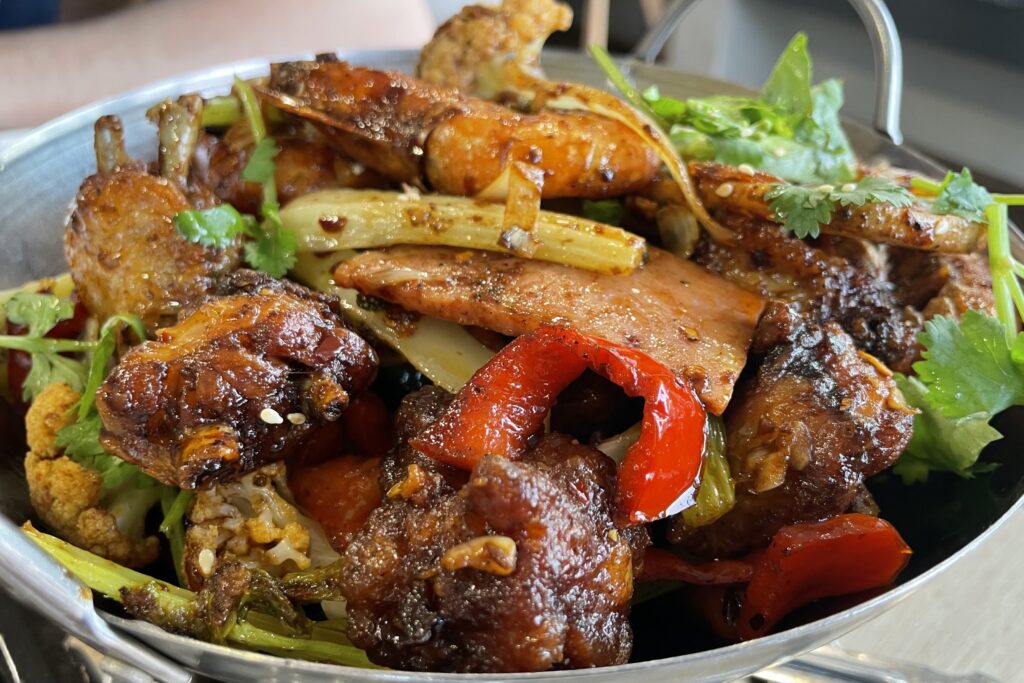
    Dry-fried shrimps, Chinese 干锅虾 (Gānguō xiā) originates from China’s Sichuan province. Fresh prawns are served in a hot pot with a variety of spices, including dried chillies, Sichuan peppercorns, garlic, ginger and spring onions. Similar to the previously introduced Gānguō Shūcài, a candle under the pot keeps the dish warm. Potatoes and vegetables such as celery, onions, peppers and cabbage are also added to add texture and flavour.

    Dry-Fried Shrimps or 干锅虾 (Gānguō xiā)

    The special feature of this dish is the “gānguō” method of preparation: the ingredients are first briefly dry-fried in a hot wok (i.e. without adding any liquid), then added to the pot and cooked. This keeps the prawns tender, while allowing the spices to release their full flavor.

    Eggplant with Fish-Fragrance“, Chinese – 鱼香茄子 (Yúxiāng Qiézi), is a dish from Sichuan province that, despite its name, does not contain fish. Fish fragrance or fish flavor refers to the special blend of spices traditionally used in Sichuan cuisine for fish dishes. This mix consists of garlic, ginger, spring onions, doubanjiang (fermented bean paste), soy sauce, vinegar, sugar and dried chilli peppers.

    Eggplant with Fish-Fragrance or 鱼香茄子 (Yúxiāng Qiézi)

    The main ingredient, eggplant, is cut into finger-length pieces and fried until soft on the inside. The eggplant pieces are then mixed with the spice mix and the onions are tossed in the pan until they have fully absorbed the flavors. The result is a harmonious blend of sweet, sour, and salty.

    Note: The spice mix is much milder than what you would typically expect from Sichuan cuisine (e.g. mala) – ideal for those who do not like very spicy food.

    The next dish lives up to its name: spicy wok, known in Chinese as 麻辣香锅 (Málà Xiāngguō), is characterized by its intense heat and spiciness. Originating from the Sichuan and Hunan regions, it combines a variety of ingredients such as meat, seafood, vegetables and tofu, all cooked in an aromatic oil made from Sichuan peppercorns and dried chilies. The name is composed of “麻” (má) for numbing spice, “辣” (là) for pungent heat, and “香锅” (xiāngguō) for fragrant pot. Málà Xiāngguō is popular not only for its distinctive “Sichuan flavor” but also for its flexibility in preparation, as the ingredients can be varied according to taste. It is an excellent example of the diversity and richness of Chinese cuisine.

    Spicy Wok or 麻辣香锅 (Málà Xiāngguō)

    Like some of the dishes described above, málà xiāngguō is served in a hot pot with an additional heat source (candle). This concept runs like a red thread through the menu of the China Haus Restaurant in Frankfurt.

    One of the absolute classics of Sichuan cuisine is 麻婆豆腐 (Mápó Dòufu), which is not only well-known and popular in China, but has also gained international recognition.

    Mapo Tofu or 麻婆豆腐 (Mápó Dòufu)

    Its history is particularly interesting: Mapo tofu dates back to the 19th century and was named after the wife of a restaurant owner in Sichuan, who was nicknamed “Ma Po”, meaning “old woman with pockmarks”.

    The main ingredients are diced tofu, ground meat (usually pork or beef), fermented black beans, chili bean paste (doubanjiang), and Sichuan peppercorns. Mapo tofu has a rich umami flavor profile created by the combination of spicy, savory, and slightly tangy flavors.

    狼牙排骨 (Lángyá Páigǔ), translated as “Wolf Fang Ribs”, are tender and crispy pork ribs marinated in a spicy sauce and then fried. The marinade is typically a mixture of soy sauce, garlic, ginger, Shaoxing rice wine and various spices. The name refers to the special preparation method, in which the ribs are cut in such a way that they resemble wolf fangs.

    Wolf Fang Ribs or 狼牙排骨 (Lángyá Páigǔ)

    The preparation of Lángyá Páigǔ requires skill and care to ensure that the ribs become crispy and absorb the full flavor of the sauce. The ribs are sprinkled with sesame seeds and garnished with small French fries and chili.

    Another Sichuan dish, 鱼香肉丝 (Yúxiāng Ròusī), consists of thinly sliced pork cooked with mushrooms, bamboo shoots, and bell peppers in a spicy sauce.

    Fish-flavored Pork or 鱼香肉丝 (Yúxiāng Ròusī)

    The name of the dish, which literally translates as “fish-flavored pork“, is somewhat misleading because, like the previously introduced eggplant dish, it contains no fish. This dish also uses the special seasoning sauce made from fermented chili beans, garlic, ginger, scallions, soy sauce, vinegar and sugar. This unique combination gives the dish its characteristic sweet, sour and salty flavor.

    Note: A slightly milder “fish fragrance seasoning mix” is used here, similar to the eggplant dish introduced earlier.

    One of my all-time favorite dishes that I used to eat regularly in China is 番茄炒鸡蛋 (Fānqié Chǎo Jīdàn). It consists of sliced tomatoes and scrambled eggs stir-fried together in a frying pan.

    Tomatoes and Scrambled Eggs or 番茄炒鸡蛋 (Fānqié Chǎo Jīdàn)

    First, the scrambled eggs are cooked in the pan, then taken out and the previously chopped tomatoes are stir-fried until they are soft and have released their juice. Then the scrambled eggs are added, everything is mixed well and seasoned with salt and sugar, as well as spring onions and garlic.

    Scrambled eggs with tomatoes are light, nutritious, easy and quick to prepare and very tasty. It is an excellent side dish to other authentic Chinese dishes with fish, meat or vegetables.

    Note: This dish is suitable for those who do not like it too spicy.

    青椒肉丝 (Qīngjiāo Ròusī) consists of thinly sliced pork and green pepper. The name is composed of the words “青椒” (green pepper) and “肉丝” (meat strips). The dish is known for its simple preparation and balanced flavor, which comes from the combination of tender pork and crunchy vegetables.

    Sliced Pork and Green Pepper or 青椒肉丝 (Qīngjiāo Ròusī)

    The pork is cut into fine strips and stir-fried in hot oil until tender and juicy. The green peppers are also cut into strips and stir-fried with the meat in the pan. The dish is seasoned with soy sauce, rice wine, and often a little sugar to achieve a balanced sweet and salty flavor with a slight spiciness.

    In each of the above dishes, rice is served as the carbohydrate base, ideal for balancing the flavors of Sichuan and absorbing the heat and oil. I hope you enjoy our little compilation of dishes from China Haus – feel free to leave a comment below.

  • Ultimate Guide to Authentic Malatang Dining in Frankfurt’s City Center

    Ultimate Guide to Authentic Malatang Dining in Frankfurt’s City Center

    Today I’d like to introduce you to 香香麻辣烫 XiangXiang Malatang (Spicy Hotpot), a restaurant that has been a favourite of both Asians and locals in Frankfurt for years. Conveniently located in the heart of Frankfurt’s city centre, close to the Römer square in the old town, this place specialises in malatang, a popular dish from authentic Chinese cuisine, as the restaurant’s name suggests.

    Restaurant Profile
    • Name of the Restaurant: 香香麻辣烫 XiangXiang Malatang(Spicy Hot Pot)
    • Adress: Berliner Str. 64, 60311 Frankfurt am Main
    • Style: Chinese Cuisine
    • Price: around 15 – 25 EUR per Person (incl. Drinks and Tips)

    Before going into the details of this malatang restaurant, let me give you some background information: Malatang (麻辣烫) originates from the Sichuan region, known for its spicy and aromatic cuisine. The name ‘malatang’ is made up of the Chinese words ‘ma’ (麻) meaning ‘numbing’, ‘la’ (辣) meaning ‘spicy’ and ‘tang’ (烫) meaning ‘hot’ or ‘boiling’. It describes a hot soup that is both spicy and mildly numbing due to the use of Sichuan peppercorns and chilli. We have already introduced the concept of mala in previous articles (e.g. Höfchen Restaurant in Frankfurt, Zhuge Grillfish in Frankfurt or Seen in Munich).

    At XiangXiang Restaurant, the focus is on Dongbei malatang – a variation of malatang from the Dongbei (东北) region of northeast China, known for its unique culinary traditions. The main difference between Dongbei malatang and Sichuan malatang is the intensity of the heat and the specific spices used in the broth. Sichuan malatang is famous for its high level of spice and the distinctive taste of Sichuan pepper, while Dongbei malatang is generally milder and more accessible to many people, with an emphasis on savoury and umami flavours. In addition, Dongbei Malatang uses a seasoned sesame paste as a dipping sauce to add a creamy, nutty note and balance the spicy broth.

    Unlike the traditional hotpot, malatang is not eaten from a single large pot in the middle of the table; instead, each person has his or her own bowl. The great thing about this dish is that you can customise it to your liking.

    Here’s a quick DIY guide to get you started. Simply grab a bowl at the entrance and a pair of tongs to fill your bowl with some of the ingredients from the large bar. Your chosen ingredients will then be cooked by the kitchen staff in a broth of your choice and served to you.

    Let’s start with your soup ingredients. You have a wide range of vegetables to choose from, including bok choy, spinach, broccoli and bean sprouts. Consider adding mushrooms, such as champignons and the wood ear mushrooms, which are very popular in China. Include different types of tofu, a variety of noodles, fried eggs and dumplings. For protein, you can choose from a range of meats – cured, sliced or in the form of meatballs – and seafood options such as prawns and squid. There are also many other delicious options to choose from.

    The choice is truly vast, with over 10 different types of noodles alone. Take your time to look at everything carefully, then use the tongs to place your chosen ingredients in your bowl.

    There’s no one ingredient that stands out from the rest – it’s all about personal taste. However, we suggest focusing on fresh ingredients and creating a vibrant variety of flavours. Start with your choice of noodles as the base, then add vegetables, mushrooms and tofu, meat (especially meat rolls, which are very popular with Asians) and perhaps some seafood, depending on your taste.

    Once your bowls are filled to your satisfaction (note: sometimes we tend to overestimate our appetites, so choose your favourite ingredients wisely), feel free to grab a drink from the fridge and take your bowl to the reception area. Here you’ll be asked to choose your soup base from the following options:

    • A spicy red chilli base (Mala 麻辣) with Sichuan pepper and chillies – a timeless classic,
    • A highly spicy broth with green Sichuan pepper (藤椒 Teng Jiao), known for its fresh, citrusy notes, different from the red Sichuan pepper found in the Mala broth,
    • Tomato broth (番茄 Fan Qie), which offers a subtle blend of sourness and sweetness,
    • Gentle beef broth (骨汤 Gu Tang), made from beef bones and simmered for a long time – the basic choice,
    • Hot and sour broth (金汤 Jin Tang), known as ‘golden broth’ for its bright yellow colour,
    • And finally, Spicy Lemon Broth (柠檬金汤 Ning Meng Jin Tang), a variation on the golden broth, infused with lemon for a refreshing twist.

    With each of these broths, you can adjust the spice level to your liking. If you like a particular broth but want it to be milder, simply order it with less spice.

    Once you’ve chosen your broth, you’ll be given a numbered token. Above the ingredient station you’ll see a numbered board. When your soup is ready, your number will be announced. Just a heads up: The announcements are in Chinese, so if you don’t understand, just check the board for your number.

    While you’re waiting for your soup, you can start making your dipping sauce. It’s the same method as for hot pot (see one of our previous blog posts for detailed instructions). For dongbei malatang, the basic element of the dipping sauce is sesame paste. Spring onions, garlic and perhaps some spices may be added. We prefer a traditional mix of sesame paste, coriander, spring onions, garlic, cumin and a touch of chilli oil. As dips can be made fresh for any occasion, we encourage you to explore different combinations to find your perfect blend.

    Once your number has been called, please proceed to the counter to collect your freshly prepared malatang. You will be given a deep spoon for the soup and a pair of chopsticks to enjoy the ingredients. Dip each ingredient from your bowl into the dipping sauce you have prepared, but be careful as some broths are very spicy.

    Malatang is all about variety and flexibility, allowing you to choose from a wide range of ingredients and customise your bowl. The distinctive, flavourful broths are created by blending spices such as Sichuan pepper and chilli, ensuring every bite is uniquely delicious.

    The soups are quick to prepare, the ingredients are healthy and the meal is a social experience with friends and other guests.

  • Tejeda and More: Exploring Gran Canaria’s Mountain Oasis and Dining

    Tejeda and More: Exploring Gran Canaria’s Mountain Oasis and Dining

    Previously, we headed north from Maspalomas towards the iconic Roque Nublo. A short 30-minute drive further north into the center of the island will bring you to the picturesque town of Tejeda. Located not far from each other, Roque Nublo and Tejeda are popular destinations that are often visited together, allowing travelers to enjoy both stunning locations in one trip.

    The drive from Maspalomas to Tejeda took us about 1.5 hours, winding through verdant landscapes and ascending into the mountains. As we neared Tejeda, the scenery transformed, revealing terraced green fields and classic Spanish white-washed houses dotting the hillsides.

    Upon arrival, the first sight that caught our eye was the serene church dominating the central square. Painted in white and orange, it stood against a backdrop of rugged mountains and lush vegetation, under a perfectly blue sky without a cloud in sight.

    Tejeda, at an elevation of about 1,050 meters (3,445 feet) above sea level, offers a naturally cooler climate compared to the coastal areas. Surrounded by lush greenery and enjoying the crisp mountain air, it felt like a world away. The expansive views and the quietude of the surroundings were simply refreshing.

    The peaceful ambiance of the town is perfect for a leisurely stroll. Though small, Tejeda is full of little surprises, with flowers and greenery blooming everywhere. A casual glance reveals scenes like living paintings, as if they were meticulously designed to captivate the heart.  

    If you want to sit down and relax, there are plenty of spots to enjoy the local flavors, whether it’s a full meal, a light snack, or a café treat.

    The town of Tejeda seems to be a haven for dessert lovers, with numerous renowned pastry shops lining the charming streets. We stumbled upon an inviting ice cream shop named LaLexe and tried four delicious flavors.

    LaLexe Con Gofio delivered a unique and comforting blend of nutty and slightly sweet gofio—a traditional Canarian flour made from roasted grain—combined with the creamy richness of the ice cream base. Hierbahuerto Con Toque De Menta tasted like a garden in a scoop. The herbal and slightly citrusy notes of the spearmint (hierbahuerto) were refreshing and cooling, with just a hint of fresh mint.

    The Mango flavor burst with the tropical sweetness and juicy flavors of ripe mangoes. The Dark Chocolate ice cream didn’t disappoint with its deep, intense flavors, bitter and smooth.

    There was just no better way to savor the moment than by letting the majestic mountain views enhance every sweet, indulgent bite.

    As we went deeper into the town, we discovered a range of accommodations, from rustic rural hotels and cozy guesthouses to charming holiday rentals, priced from €70 to €150 per night. Located right in the middle of the rugged mountains, these lodgings offer a tranquil getaway and an immersive experience in the island’s natural beauty. There’re also plenty of outdoors activities to enjoy nearby, particularly hiking and climbing.

    However, prepare for lots of zig-zagging mountain roads when driving back to your hotel. If you plan on exploring the entire island frequently, this is something to keep in mind.

    Despite the winding roads, the drive to Tejeda is nothing short of breathtaking. The endless mountain ranges unfold like a dynamic canvas, each layer revealing more of the stunning landscape. You can gaze far into the distance, even catching a glimpse of the Teneriffa island, stretching all the way to the sea horizon —a view that truly rejuvenates the spirit.  

    On our way back to Maspalomas, just a short 15-20 minutes’ drive from Tejeda, we passed by the fascinating hiking trail, Roque Bentayja. The hike is relatively short yet rewarding, taking about 20 minutes to reach the top. From there, the view is just amazing – majestic mountains sprawling far and wide under the clear blue sky.

    Roque Bentayga holds deep archaeological significance as a sacred site for the ancient Canarian people. It features caves and rock shelters used for dwellings, burials, and likely rituals and astronomical observations. The ancient inhabitants were really ingenious, having constructed such structures atop this prominent peak, where they could enjoy the awe-inspiring panoramic views round-the-clock.

    About an hour’s drive southwest of Roque Bentayga, on the road to Maspalomas, lies the beautiful village of Fataga. Nestled deep in the mountains of San Bartolome de Tirajana, it’s often shrouded in a veil of clouds, giving it an almost ethereal atmosphere. Adding to its charm are the colorful flags adorning the rooftops and the intricate wall murals depicting scenes of suns, birds and other lively motifs.

    The combinations of Fataga’s mystical vibe, colorful decorations, and serene surroundings brings to mind the Tibetan scenery, where the payer flags flutter in the wind and the religious art invokes peace and spirituality.

    Tips for your visit:
    • Culture and Heritage: Immerse yourself in Tejeda’s rich cultural heritage through its traditional architecture and charming squares. You can visit the Museo de la Historia y Tradiciones de Tejeda for a deeper understanding of its storied past. Admission costs around €2-3, and a visit typically takes 30 minutes to 1 hour. If you’re coming in January to early February, don’t miss their Almond Blossom Festival (Fiesta del Almendro en Flor). This period coincides with the blooming of almond trees in the region, transforming the area into a beautiful sea of pink and white blossoms. It is a lively celebration with traditional music, dancing, and local cuisine.
    • Hiking and Exploring the Area: The trails around Tejeda cater to a wide range of hiking abilities, offering something for casual walkers and experienced hikers alike. Within a 30-minute drive, you can reach iconic landmarks like Roque Nublo, Roque Bentayga, and Parque Rural del Nublo, all perfect for hiking and nature exploration.
    • Gastronomy: Indulge in the authentic Tejeda flavors with specialties like Mazapan oder Bienmesabe from Dulceria de Nublo. Bienmesabe a locally produced, traditional Canarian almond dessert that is especially famous in Tejeda. Other well-known local treats include goat and sheep cheese and honey.

    Restaurante La Ciudadela is like a melting pot that has it all – pizza, steaks, grilled meats, fresh fish, vegetarian grills, and even the famous noodle paella known as Fideuà.

    We were so excited by the menu that we almost went overboard with our order. But our thoughtful waiter, confident in their generous portions, stepped in and helped us scale back. So we settled on a juicy steak and a seafood fish platter.

    The sirloin steak with rice, smashed potatoes and fries is an invigorating dish. Cooked to a perfect medium-rare, the steak is juicy and flavorful, with a soft, tender inside and a hint of smokiness. The highlight is definitely the 5-pepper sauce. Just when I thought Spanish food wasn’t spicy, this sauce proved me wrong. It packs quite a punch, challenging the stereotype that most Europeans can’t handle the heat and that they think pepper is spicy. Well, maybe they were talking about this 5-pepper sauce!

    Despite the elevated heat, this sauce doesn’t lack in flavor complexity. It combines black, white, green, and pink peppers with possibly other exotic varieties, to create a distinctly bold sensation – pungent and numbing, yet at the same time floral, fruity, and a bit citrusy. It’s really one-of-a-kind.

    Its smooth texture supremely complements the savory richness and sweet undertones of the steak. It coats the steak evenly, enhancing its juiciness without overpowering it, and distributes the flavors throughout every hearty bite.

    Notably, the spiciness of 5-pepper sauce can vary. Depending on the specific peppers and recipe used, some versions may be milder. It’s a good idea to ask about the spicy level if you have concerns about heat.

    The seafood fish platter includes grilled hake, monkfish, mussels, clams, calamaries, red shrimps and Norway lobster (also known as langoustine or Dublin Bay prawn), boiled potatoes, and paired with red mojo, green mojo, and aioli.

    Beloved Canarian dipping sauces, red mojo is rich and smoky with a hint of spice, while green mojo is fresh, tangy, and herbaceous. Often enjoyed with “papas arrugadas” (wrinkled potatoes), these mojos are a staple and local favorite in Canarian cuisine.

    The seafood and fish, masterfully grilled Spanish-style, offer a light yet intensely fresh flavor and briny depths of the ocean. Grilled hake is delicately sweet, tender with a hint of smokiness, while the monkfish brings a robust, meaty bite similar to lobster. Fresh plump mussels always delight with their briny juiciness, their vibrant flavors are elevated even more when enjoyed with green mojo. Squid/Calamari tantalize with their unique, firm tenderness and crisp exterior, brimming with oceanic flavor.

    Red shrimps add a burst of sweet brininess, a perfect match for the aioli’s creamy notes. Norway lobster boasts a natural sweetness and a more delicate, succulent flavor that tastes especially good with the vibrant flavors of the mojos.

    Mix and match as you please—there are no bad combos here! But if you want our top picks, we’ve shared our highlights for you.

    After a rigorous drive on mountain roads, invigorating hikes, and some great food, we found ourselves utterly content lying by the beach. As the sun set over Playa del Inglés, the beach emptied, leaving us to recline on the sand, our bags as makeshift pillows. Above us, stars began to twinkle, painting graceful arcs across the vast sky. Gazing at the boundless sea and the celestial sway above, a wave of wistful nostalgia washed over us. Today has passed—just one of the many days in our lives. Tomorrow will bring a new dawn, and we remain ever young.

    Our next trip will be to the wild west world of Sioux City. See you soon!

  • Bangkok Restaurant: Our Go-To Spot for Authentic Thai Comfort Food

    Bangkok Restaurant: Our Go-To Spot for Authentic Thai Comfort Food

    Today, we’d like to introduce you to an authentic Thai restaurant in Frankfurt that has become a beloved staple of our weekly routine. This article is long overdue, as we’ve been visiting this spot almost every week, especially during the COVID days, when their convenient take-away lunch sets were a lifesaver. Often, we’d reheat what we couldn’t finish, and their flavors have seamlessly woven their way into our everyday home-cooked meals.

    Last time, we showcased a casual, authentic Thai eatery. This time, we’ll feature a restaurant with a different flair. Elegantly decorated with traditional Thai wooden elements and a nature-inspired ambiance, it’s perfect for gatherings with friends and coworkers alike.

    Restaurant Profile

    Before diving into the main dishes, let’s check out some of their popular appetizers.

    Giaw Grob is a traditional Thai dish, widely enjoyed across Thailand, particularly in bustling food markets. It consists of crispy fried dumplings stuffed with a savory filling of shrimp, chicken, or bamboo shoots, all served with a tangy sweet and sour sauce.

    The wonton skins are very thin, lightly fried to a crisp, delicately wrinkled exterior that holds succulent fillings within – be it briny shrimps, or tender chicken, or crunchy bamboo shoots – all promising a delightful interplay of flavors and textures.

    The chicken variation is our personal favorite. The chicken has a milder taste. Its subtle sweetness and tender juiciness simply make it the ideal foil for the savory crispy shell, delivering satisfying crunch and twist in every bite. Don’t overlook the sauce, it adds just the right amount of sourness to balance the fried food and ensure they remain moist and flavorful!

    If you’re a fan of crispy deep-fried foods, you can also try their spring rolls and fried chicken wings.

    The spring rolls are filled with a mix of chicken, carrots, white cabbage, and glass noodles. They are crunchy on the outside, and savory and slightly sweet on the inside, combining tenderness of the chicken with the crispness of the vegetables and the soft, elastic glass noodles. The dish is served with a sweet and sour sauce. The vegetarian version simply omits the chicken but retains the same good taste.

    These fried chicken wings incredibly crunchy. Marinated in a blend of turmeric, lemongrass, and pandan leaves, they have a fragrant, herbal, and slightly earthy flavor. The turmeric adds a warm, peppery taste, while the lemongrass gives a fresh, citrusy note, and the pandan imparts a nutty aroma. They are served with a chili sauce that packs quite a punch!

    Tom Yam Soup is a classic Thai dish that’s sure to awaken the senses. It features a tangy and spicy broth infused with aromatic lemongrass, fresh long coriander (culantro), green onions and earthy mushrooms. You can choose to have it with shrimp, chicken, or as a vegetarian option. Our top recommendation is the shrimp version, which is also the most authentic.

    The soup itself has a complex yet harmonious balance of flavors – a burst of bright, citrusy notes from the lemongrass, followed by a herbal, peppery undertone from the culantro and a hint of heat that warms your palate. The soup is refreshing and comforting at the same time. The earthy, umami mushrooms and the sweet, briny shrimps beautifully balance the soup’s sour and spicy notes, making each spoonful substantial and satisfying!

    At Bangkok Restaurant, most main dishes are paired with fragrant steamed rice and can be customized with a variety of proteins like beef, pork, chicken, duck, seafood, or tofu for vegetarians. Unless the dish must be made with a specific type of meat, we usually lean towards chicken. We love its mild, tender texture and how perfectly the restaurant prepares it. We can’t wait to share our favorites with you, so let’s dig in!

    First up is Gai Pad Med Mamuang Himaparn, a popular Thai stir-fry that brings together tender chicken with crunchy cashew nuts, onions, leeks, and bell peppers, all bathed in a savory soy sauce.

    This dish offers a mild yet appetizing mix of savory, sweet and slightly spicy notes. The chicken is incredibly tender and umami-rich, while the cashew nuts add crunch and subtle sweetness. The onions, leeks, and bell peppers bring a touch of freshness and a mild, sweet undertone, brilliantly balancing out the dish’s savory character. All in all, it’s a very delicious and comforting dish.

    Kio Wan Gai, also known as Green Thai Chicken Curry, is a beloved Thai dish that showcases rich, smooth flavors. It features simmering the curry paste and coconut milk, along with chicken pieces and eggplant.

    The green curry, made from green chiles, garlic, lemongrass, kaffir lime leaves, and other aromatic ingredients, is naturally a bit spicy. But the spice level can be adjusted to your liking. It stands out with a lighter taste, slightly sweet fragrance and a well-balanced, luxurious creaminess. The eggplant absorbs the curry sauce well, becoming soft and creamy. The tender chicken combines with coconut milk to deliver a velvety texture and rich, deep flavors. Its natural sweetness nicely complements the spicy, herbal notes of the curry paste.

    Pair with fluffy steamed rice and let it soak up the curry sauce for a complex, satisfying blend of – sweet, spicy, creamy, herbal, and savory tastes – all in one mouthful!

    As amazing as their chicken dishes are, let’s mix it up and try some of their delicious options with other meats, like Pad Kanah Moo Grob, or “Crispy Pork Belly with Chinese Kale.” This dish consists of crispy pork belly stir-fried with Thai broccoli (Chinese kale) and soy sauce.

    The pork belly, with its perfect mix of fat and lean meat, is fried to a golden crispness, resulting in a rich, crunchy, and slightly fatty goodness that remains moist inside. The dish carries a savory, garlicky, slightly spicy flavor profile, typical of Thai cuisine.

    The star green veggie, Chinese kale, adds a refreshing balance, cutting through the richness of the pork and keeping it from feeling greasy. This combination of the crispy, rich pork belly and the fresh, slightly bitter greens makes Pad Kanah Moo Grob a deliciously dynamic and well-rounded dish.

    Pa Naeng Nua is a rich and aromatic dish featuring succulent slices of beef in acreamy red curry sauce.

    The beef is sliced super thin, making each piece melt-in-your-mouth tender. This delicate texture allows the beef to fully soak up the flavors of the creamy coconut milk and the mildly spicy red curry. The meat is so juicy that it almost fuses with the curry, becoming a silkiness that glides smoothly on the palate.

    The curry itself is mildly spicy, balancing the heat with the sweet coconut milk and the nutty ground peanuts. This combination is a definition of velvety with a hint of warmth that enhances the flavors. The dish is a great choice for those who enjoy a touch of spice without it being too intense.

    Gaeng Pet Ped Yaang is a show-stopping Thai dish that tantalizes the senses with its vibrant colors and irresistible aromas. This dish features crispy roasted duck in red curry with creamy coconut milk, Thai eggplants, cherry tomatoes, and pineapple.

    The duck meat is very lean and tender, wrapped in crispy golden skin. The luxurious red curry, enriched with creamy coconut milk, envelops the duck in a velvety embrace. The crisp Thai eggplant and juicy tomatoes balance the richness, while the sweet pineapple introduces an exotic, tangy freshness. It’s a masterpiece of spicy, sweet, sour, and aromatic flavors.

    Take a bite of the tender duck, fully bathed in the luscious red curry, and paired with a medley of fresh vegetables and fruits, and you’ll have a taste symphony that sweeps you right off your feet.

    Ped Saam Ros features crispy duck with cashew nuts, Thai basil, and chili-tamarind sauce, it’s a tantalizing dish that combines crispy textures with bold flavors.

    The duck is roasted to gain a shiny, crunchy skin, while retaining tender and juicy meat underneath. Its richness is complemented by the nutty cashews. What also adds to the crunch is the Thai basil. Quickly fried, it lends a fresh herbal note with hints of peppery sweetness, enhancing the overall aroma.

    The chili-tamarin sauce is the key that ties each ingredient together. It brings a tangy, slightly sour note with a subtle sweetness. Combined with chili, it adds a spicy kick that elevates the rich savoriness of the duck and keeps the dish moist with a glossy sheen.

    Eat it with fragrant steamed rice for a deeply satisfying and invigorating meal. This dish is rich in meaty flavors, with a delightful crunchy nuttiness. If it’s a bit too rich for your taste, consider asking for a wedge of lime to squeeze over it—it brightens and refreshes beautifully.

    Many may perceive authentic Thai food as intensely spicy, especially when thinking about the dishes from the Northeastern region (Isan cuisine). But in fact, many Thai dishes are quite mild. They’re renowned for their smooth blend of sweet, sour, salty, bitter, and spicy flavors. At Bangkok Restaurant, every dish strives to balance these flavors, ensuring that none overpower the others. So they won’t be overly spicy. By using unique Southeast Asian ingredients like lemongrass, kaffir lime leaves, and Thai basil, the result is a unique taste sensation where different flavors come alive on the palate at the same time.

    This restaurant also has an impressive selection of dishes, many of which are considered Thailand’s most famous and tasty, like Tom Yum Soup, Kio Wan Gai, and Gaeng Pet Bet Yaang (grilled duck in red curry). Whether you’re a seasoned Thai food lover or just starting to explore, you can find something here that makes you happy.

  • A Flavorful Sequel: Continued Magic from Höfchen’s Sichuan Kitchen

    A Flavorful Sequel: Continued Magic from Höfchen’s Sichuan Kitchen

    In our previous posts, we may have teased your taste buds with a glimpse into the spicy world of authentic Sichuan food at Höfchen Restaurant in Frankfurt. Known as one of the flagship Sichuan restaurants in Frankfurt, this place offers a dazzling array of Sichuan dishes that go far beyond what we’ve showcased so far.

    Sichuan cuisine, one of China’s four major culinary traditions, is celebrated for its bold, spicy, and numbing flavors, as well as its impressive array of cooking techniques. It typically uses wild and foraged ingredients from the mountains, fresh seafood, and vibrant vegetables, all seasoned with the likes of Sichuan peppercorns, chilies, fermented bean paste (or 豆瓣酱), and fermented tofu (or 腐乳). With over 40 cooking methods, from sizzling stir-fries to oil-soaked crispy fries, the flavors are anything but ordinary.

    Today, we’re diving back into this thrilling and mouth-watering world, ready to embark on a sequel of taste adventure that’s both exotic and irresistibly delicious!

    Restaurant Profile

    Mao Cai (冒菜 or Chengdu Fondue) is a beloved dish originating from Sichuan with a rich history dating back to the Late Han Dynasty (mid-2nd century CE to 220 CE) and the Three Kingdoms period (220 to 280 CE). By the Western Han era (206 BC to 9 AD, Sichuan cuisine had already begun to take shape, thanks to the widespread use of well salt, which fostered a local preference for bold and spicy flavors.

    In the “Ode to Shu” by Western Jin poet Zuo Si, there is a mention of “调夫五味” (adjusting the five flavors), highlighting the use of medicinal herbs for seasoning. During the late Eastern Han Dynasty, constant warfare brought various illnesses to the troops, which reduced their appetite. Military doctors, to prevent disease spread and stimulate the soldiers’ appetites, instructed cooks to add medicinal herbs to their dishes. These herbs not only provided therapeutic benefits, but also enhanced the flavors. Over time, the cooks discovered that blanching various vegetables with these herb-infused broths resulted in tastier dishes that became favorites among the soldiers. This method of cooking, known as “Mao Cai,” spread throughout the military.

    When these military cooks retired and returned to civilian life, they took this cooking method with them and opened “Mao Cai” restaurants, which quickly became popular and led to an era of unprecedented prosperity for Mao Cai.

    Today, Mao Cai is enjoyed across China, with regional variations to suit local tastes. There are different styles, such as hot pot Mao Cai, clear broth Mao Cai, mildly spicy Mao Cai, and vine pepper Mao Cai. At Höfchen, the Mao Cai leans towards the hot pot style, essentially offering a personal hot pot experience.

    The broth is prepared using dozens of harmless medicinal herbs, combined with secret seasonings and common spices like dried chilies, Sichuan peppercorns, fermented bean paste (豆瓣酱), star anise, fennel, and sugar. These ingredients are stir-fried over low heat until the oil turns red, then deglazed with cooking wine and water to create a rich, flavorful base.

    Various ingredients such as potato slices, lotus root slices, cauliflower, konjac noodles, tofu, wood ear mushrooms, potato noodles, mushrooms, tripe, pork belly, luncheon meat, crab sticks, shrimp, and tender beef are added to this broth, absorbing its deep flavors. Finally, it is finished with a drizzle of red oil, salt, chopped green onions, minced garlic, and sesame oil.

    Mao Cai is characterized by its spicy, numbing, and aromatic qualities that awaken the taste buds. The spicy flavor is the soul of Mao Cai, enhancing aroma, reducing greasiness, masking off-flavors, stimulating appetite, dispelling dampness, and warming the body. The ingredients themselves, whether meat or vegetables, release their natural flavors during cooking, making the dish both satisfying and appetizing. The broth, while flavorful, is generally not consumed on its own.

    Mao Cai is probably one of the most representative dishes from the exotic and irresistibly delicious world of Sichuan cuisine.

    Originally a signature dish from Xinjiang, Lamb Meat with Cumin (孜然羊肉 or Lammfleisch mit Kreuzkümmel) has made its mark in Sichuan cuisine circles. Perhaps it’s the fiery flair of cumin perfectly matching the zest of Sichuan flavors that has made it a hit among Sichuan cuisine lovers.

    Cumin boasts a unique oily richness and a strong fragrance that adds depth to dishes. Its earthy, warm, and spicy aroma not only masks the gaminess of lamb, but also highlights its natural clean, slightly sweet freshness, creating a perfect balance. This paring has thus become one of the best ways to prepare lamb in the region.

    Made from succulent lamb shank, cooked with fresh cilantro leaves and an array of spices, Höfchen’s method brings out the natural succulence of the lamb. Each bite evokes the sensation of savoring grilled skewers—slightly charred on the outside, yet juicy and plump on the inside. Covered in rich cumin and chili, every mouthful bursts with flavorful tenderness and enticing aroma that’s almost addictive!

    Pork Belly in Chili Garlic Sauce (Schweinbauch in Chili-Knoblauch Sauce or 蒜泥白肉) is a classic Sichuan dish. It features boiled, thinly sliced pork belly, ensembled with crisp cucumber slices, all dressed in a flavorful mix of soy sauce, chili oil, vinegar, sesame oil, a touch of sugar, and a fresh, fragrant garlic paste.

    As soon as the dish arrives, the tantalizing aroma of Mala (numbing) spice and fresh garlic hits you head-on. The pork belly itself is very succulent and juicy. Boiled in clear water with skin on, it takes on a rich and glossy appearance. Cut evenly, each slice curves delicately after cooking. Thanks to the fine balance of lean and fat, the meat has a tender, non-greasy texture.

    The sauce beautifully enhances the natural richness of the pork belly, delivering a mouthwatering blend of spicy, tangy, and garlicky flavors, finished with a hint of sweetness. Pair the soft, juicy pork with fresh, crunchy cucumbers to keep the dish light, refreshing, and utterly indulgent.

    Sichuan-Style Sauerkraut with Steamed Lotus-Leaf Buns (Sauerkraut nach Sichuan-Art mit Dampfnudeln in Lotusblatt-Form or 芽菜鸭米荷叶夹) features tender, flavorful duck meat combined with pickled mustard greens (芽菜) and served with soft, steamed buns shaped like lotus leaves.

    This dish is known for its harmonious blend of flavors and textures. The small, chopped pieces of duck meat are tender and juicy, infused with the sour savoriness of the region’s famous pickled mustard greens. Each bite bursts with tangy, umami-rich, deep flavors, perfectly complemented by the subtle heat of chili peppers and the aromatic note of shallots.

    Accompanying this flavorful mix are the steamed lotus leaf buns (荷叶饼). These fermented buns, often referred to as the “universal bun”, are soft, pillowy, and incredibly versatile. Their mild texture makes them the perfect vessel for all kinds of savory fillings. Simply tuck the savory duck and tangy pickled mustard greens mixture into the buns, and take a generous bite that’s soothing, flavorful, and fully satisfying.

    水煮牛肉 (Water-Cooked Beef in Chili Oil or Rindfleisch in Chiliöl) is an iconic Sichuan dish that embodies the essence of Sichuan’s fiery flavors. At first glance, this dish may seem intimidating, as it’s abundantly adorned with dry chili peppers, earning it a reputation as one of the spiciest in Sichuan cuisine. Beneath the sea of chili lies the tender, flavorful beef and crisp veggies like bean sprouts.

    Looking rich and luscious, each slice is covered with chili oil that glistens invitingly. It doesn’t taste greasy, but delicately oily and very appetizing. Not fried, but gently poached, the beef remains tender and juicy with a smooth and silky texture. Enhanced by the generous use of dry chilies and Sichuan peppercorns, the beef boasts a robust, spicy flavor that elevates its natural hearty richness. The intense aroma and fiery sensation evoke the spirit of Sichuan hotpot, while the bean sprouts offer a refreshing crunch that helps balance the heat.

    干煸四季豆 (Dry-Fried Green Beans or Gebratene Grüne Bohnen) is a flavor-packed Sichuan classic. The green beans themselves offer a slightly sweet and fresh taste, with a juicy interior encased in a crisp, slightly chewy exterior. Being deep-fried, each bean segment has a mild, smoky flavor and a distinctive wrinkled appearance.

    The seasoning of minced garlic, ginger, and Sichuan peppercorns imparts an aromatic and slightly numbing spiciness, characteristic of Sichuan cuisine. The dried chili peppers lend a fiery kick, while soy sauce and a touch of sugar balance the heat with savory, subtly sweet undertones.

    While usually prepared with minced meat for added umami richness, you can easily ask for a vegetarian version from the kitchen. Even without meat, the spices and seasonings ensure the dish remains robust and satisfying.

    鱼香茄盒 (Auberginetasche Gefüllt mit Schweinehackfleisch in Süß-Saurer Soße or Eggplant Pocket filled with Minced Pork in Sweet and Sour Sauce) is a renowned delicacy in Sichuan cuisine.

    At the heart of this dish are soft eggplants, bursting with juicy freshness, sandwiching minced pork fillings. They’re wrapped in a thin, translucent batter made from egg whites, and then deep-fried until the outside turns into a golden crust.

    It’s not a fish dish, but it has the taste of a simmering fish. This iconic 鱼香 (fish fragrant) flavor is achieved by weaving together the tang of pickled peppers, the subtle heat of ginger, and the sourness of vinegar.

    Seasoned with shallots, chili peppers, and red pickled peppers, each mouthful is an appetizing blend of pickled sourness, subtle sweetness, and a hint of garlic and spice that is sure to awaken the senses. Sink your teeth into the crip eggplant pocket and you’ll reach the savory, umami goodness of the juicy pork. Crafted from carefully selected lean and fatty cuts, the fillings are moist and incredibly rich in flavors!

    Bingfen (or 冰粉) is a Chinese dessert loved by many locals.

    While we’ve covered bingfen in our previous posts, the bingfen served at Höfchen deserves a special mention. Unlike in China, the bingfen here has a slightly thicker jelly consistency that provides a more solid mouthfeel. Served cold and decorated with various toppings like sesame seeds, date pieces, goji berries (枸杞), and hawthorn (山楂), each spoonful delivers vibrant, refreshing flavors – tangy sweetness, bright tartness, slight nuttiness, and chewiness from the dry dates. It’s a perfect treat for cooling down after a fiery Sichuan feast or simply on a hot summer day.

    Sichuan cuisine is said to have “a hundred flavors and a hundred dishes.” It brings together irresistible tastes like numbing spice, peppery heat, and fish fragrant flavors. Today, we’ve delved into some of the iconic dishes to experience their charm. But our journey doesn’t end here; we’re eager to dig deeper and uncover more authentic flavors cherished in local households or in mountain villages and fields. If you’re intrigued, stay tuned for more posts featuring diverse, adventurous, spicy, and tantalizing dishes.

  • Irresistible African Queen platter: A spicy and savoury feast awaits!

    Irresistible African Queen platter: A spicy and savoury feast awaits!

    As you know, we love Asian food, but we’re always open to culinary adventures from other parts of the world. So today I would like to introduce you to one of the best African restaurants in Frankfurt: The African Queen Restaurant.

    Both Erta Ale, which we reviewed in a previous post, and The African Queen offer homemade East African cuisine. While Erta Ale primarily serves Ethiopian dishes, The African Queen specializes in Eritrean cuisine.  Given the geographical and cultural similarities between the two countries, there is a considerable overlap in their culinary offerings.

    Restaurant Profile

    The African Queen Restaurant offers a delicious selection of lamb, beef and chicken dishes, all well seasoned and accompanied by vegetables. Vegetarians and vegans will also find plenty to enjoy, such as hamli (a spinach dish with tomato sauce) or shiro (ground chickpeas).

    To whet our appetites before the main course, we opted for sambusas as a starter. These delicious pastry pockets are generously stuffed with minced meat and served with a delicious herb dip.

    Sambusas are a popular starter or snack in many African and Middle Eastern countries. They are similar to the samosas commonly found in South East Asia. Sambusas can be baked or fried and are usually served with yoghurt sauce or chutney. The dough is thin and crispy, while the filling is flavourful and moist.

    Unlike samosas, which often feature spices such as turmeric, cumin, coriander, and garam masala, sambusas contain a blend of regional African spices such as berbere (an Ethiopian spice mix), harissa, or ras el hanout.

    We complemented our meal with some delicious African beers: Dju Dju and Ma Suwa.

    Dju Dju, also known as palm wine or palm wine beer, is a traditional West African drink made from the sap of the oil palm. The sap is carefully tapped, collected and then fermented to raise its alcohol content to around 3.6%. This beer has a mild, slightly sweet and fruity profile. Flavours include passion fruit, pineapple, banana and mango.

    Ma Suwa is brewed with fermented teff flour, a gluten-free local grain, and a special yeast derived from sorghum. This beer has a subtly sour taste with a distinct yeasty character. If you choose one of the banana, mango and coconut flavours, it is further enhanced with a fruity note.

    Both beverages are elegantly served in coconut bowls, a tradition cherished in the rural areas of Eritrea.

    Our main course – the African Queen Tasting Platter, ideal for two or more people – is the absolute highlight and best-seller in the restaurant. It’s a platter full of flavours, spices and fresh ingredients that will leave you wanting more with every bite!

    The African Queen platter serves a variety of classic Eritrean dishes all at once. Meat dishes of chicken, beef and lamb in a variety of sauces, egg, spinach, ground chickpeas, potatoes and much more. There really is something for everyone!

    The platter is served in a colourful mesob, a traditional, intricately woven straw or reed basket. Once the basket is on the table, the waiter lifts the lid of the mesob, revealing the large platter with all its exotic African scents and colours.

    It is served with injera, a traditional flat, airy bread widely used in Ethiopian and Eritrean cuisine. Like suwa, it is made from teff flour. What makes injera special is its fluffy texture and sour taste, which comes from a fermentation process.

    To fully enjoy the African Queen platter, it is traditionally eaten with the hands. Tear off a piece of the slightly sour and nutty injera and place small portions of your favourite food on it. If you like, you can top it off with some spicy berbere or awaze.

    Berbere is an aromatic blend of spices including chilli, garlic, ginger, basil, fennel and coriander. Awaze is a spicy paste or sauce made from berbere, garlic, ginger, lemon juice and sometimes honey or wine.

    Both dips give the dish an irresistible, addictive, spicy and fiery taste, perfect for lovers of spicy cuisine.